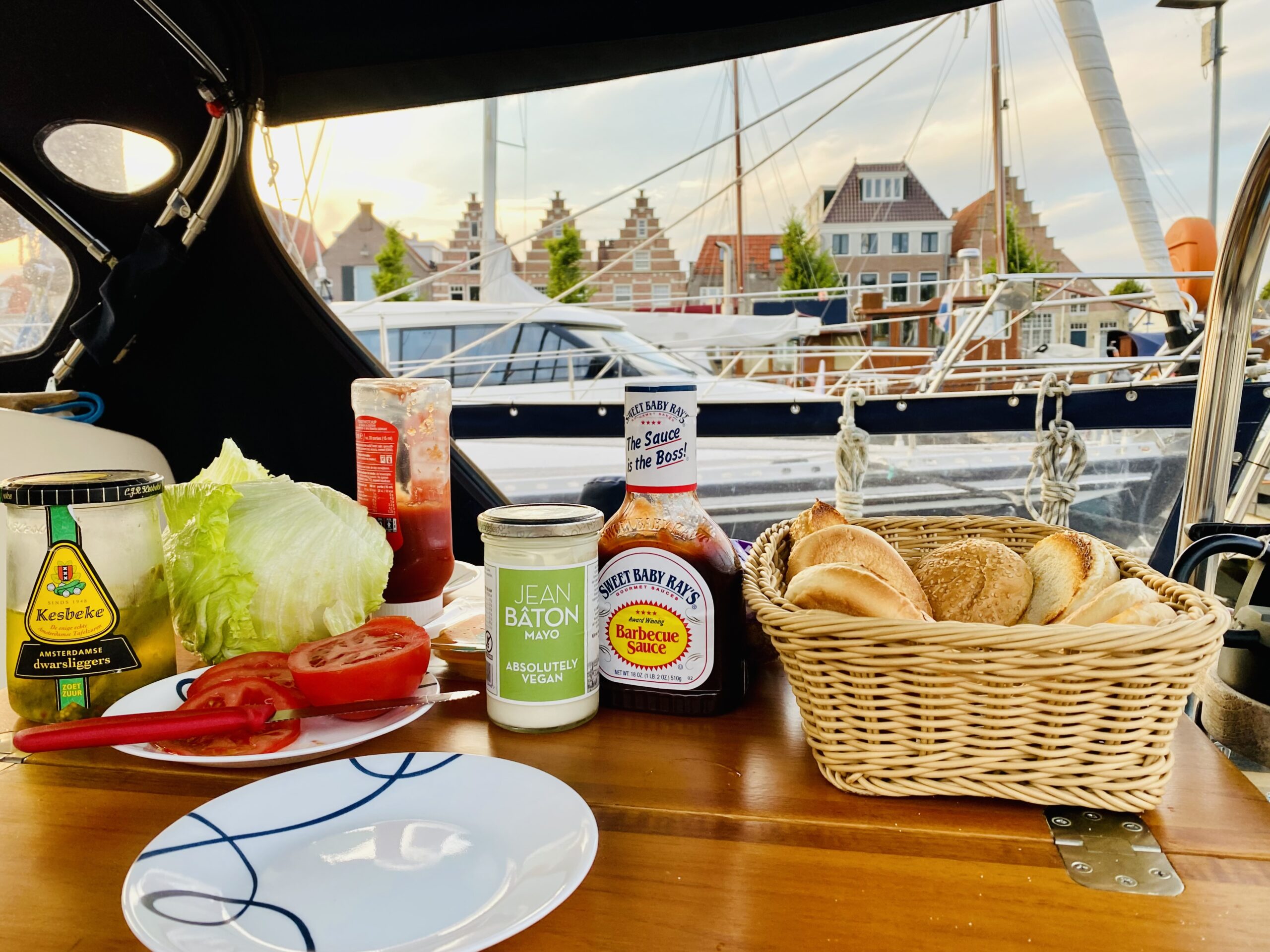
The first weekend on our sailing boat was unfamiliar and exciting. We especially had to get used to cooking with gas. We were also short of crockery and cooking utensils. Would we ever manage to fit enough into this tiny kitchen to cook properly?
As it turned out: it works very well indeed. You really do not need that many things, and with a bit of practice we cooked our first Christmas menu in December 2022 on a single induction hob.
Our pantry
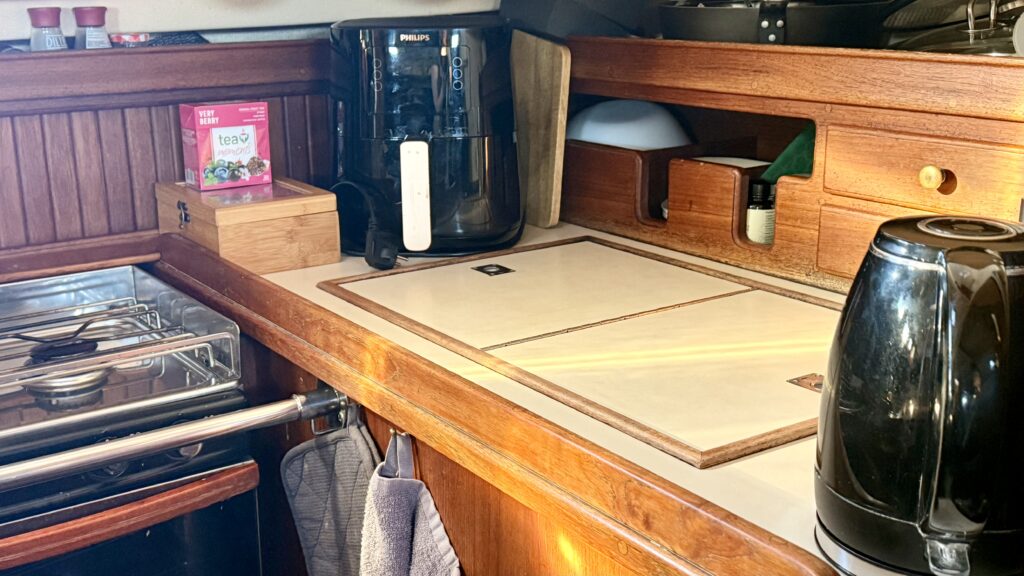
In our U-shaped pantry we have a large sink cupboard with a double sink, a gas cooker, and a big fridge. It is a very practical layout, even at sea. The sink cupboard offers enough space for the things we often need for cooking (spices, baking ingredients, etc.) as well as for some food items (porridge oats, bread, nuts). Not everything fits in there, though, so we also have extra storage space for basics such as pasta, rice, and porridge oats in an additional airtight storage box.
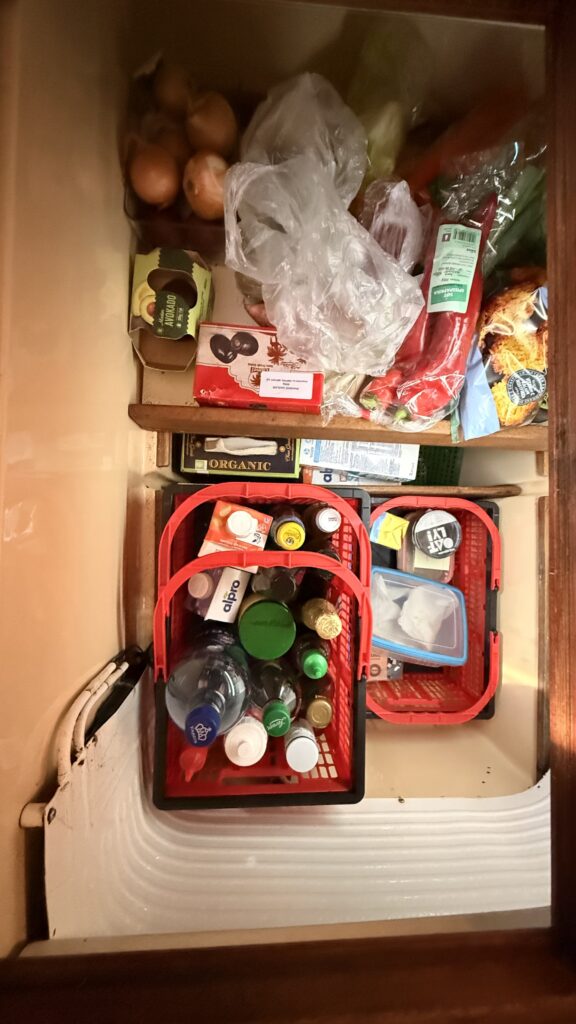
Our fridge holds roughly 350 litres, so it is about the same size as the one in our flat. Unfortunately, it is not particularly well insulated, which makes it quite a power guzzler. And it does not have a freezer compartment, which we do sometimes really miss. We fitted part of the large interior with foldable baskets (Bauhaus), which makes it easy to get to things. At the top there is a magnetic cupboard light with a motion sensor, so the light comes on as usual when you open it.
Swell and heeling
On board a boat, everything needs to be reasonably shatterproof and/or stowed away securely. That is why many of our kitchen utensils are made of metal or, where it cannot be avoided, plastic. For crockery we use Corelle® (a US brand of durable glass tableware). It has come through our four years of boat life completely unscathed so far. We deliberately do not use plastic boat crockery, as it generally contains melamine — a substance suspected of being carcinogenic. For that reason, bamboo crockery is not an alternative for us either.
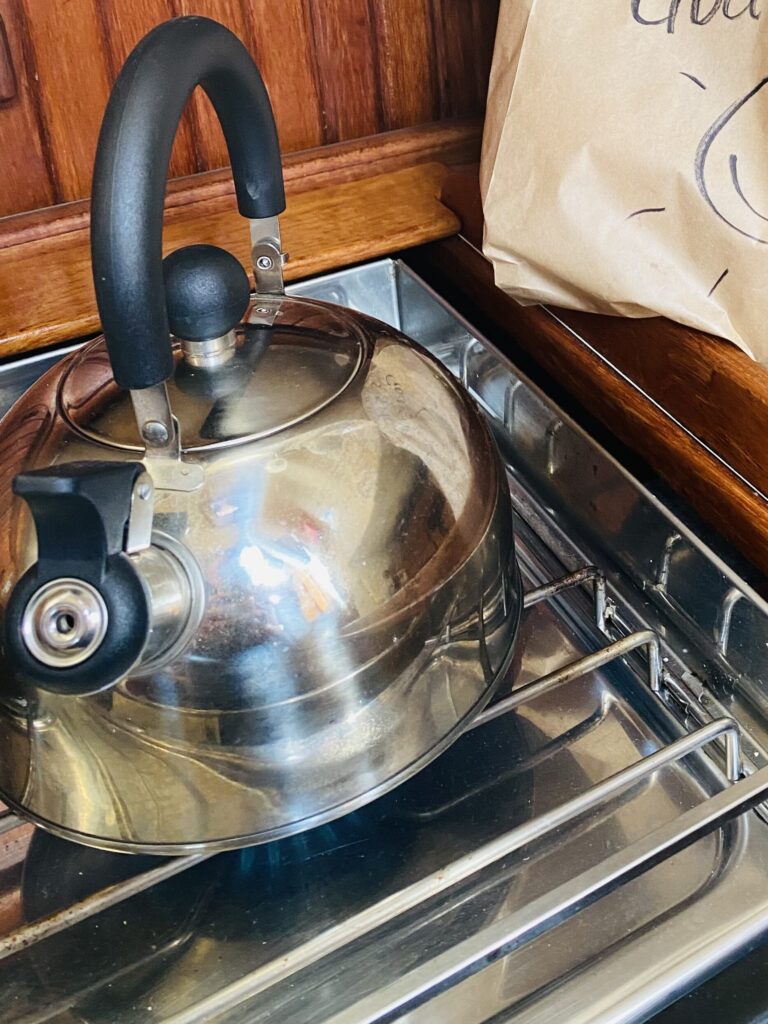
Must-haves for the galley
These are our absolute pantry favourites.
To be able to cook at sea, the cooker has to be gimballed so that the hob stays level even when the boat is heeling heavily. The U-shape of the pantry is well suited to wedging yourself into it at sea and having at least a reasonably secure stance. There is also an eye on the right and left of the cooker so you can clip yourself on. But honestly: we have never yet had to cook in such adverse conditions.
Lack of space
As with many other things, the same applies to fitting out the galley: less is more. Our air fryer is not really essential. But the chips you can make in it are simply too good. Worlds better than what we could manage in the gas oven. Annoyingly, though, it does not fit into any of our cupboards. We wedge it in place while we are under way, so at least normal wave motion is not a problem.
3 things that have turned out to be unnecessary (so far):
- Garlic press (we always chop it)
- Sprouting jar (sadly it takes too much water to rinse it every day while growing sprouts)
- Espresso pot (we always use our French press)
3 things we would take with us again:
- Hand blender
- Kettle
- IKEA induction hob
3 things we sometimes miss:
- Moulinette
- Freezer box
- Waffle maker
Limited resources
On a boat, resources are generally not available in unlimited quantities. If you do not have a watermaker, you do not have an endless supply of fresh water on board. If you cook with gas, like we do, you have a maximum of two bottles on board. And electricity, unless you make sure there is enough coming in or are equipped to be completely self-sufficient, is also only available to a limited extent. So the rule is to use these resources sparingly.
➡️ Our article about resources on board. (coming soon!)
Our galley – Setup & basics
Cooker & energy
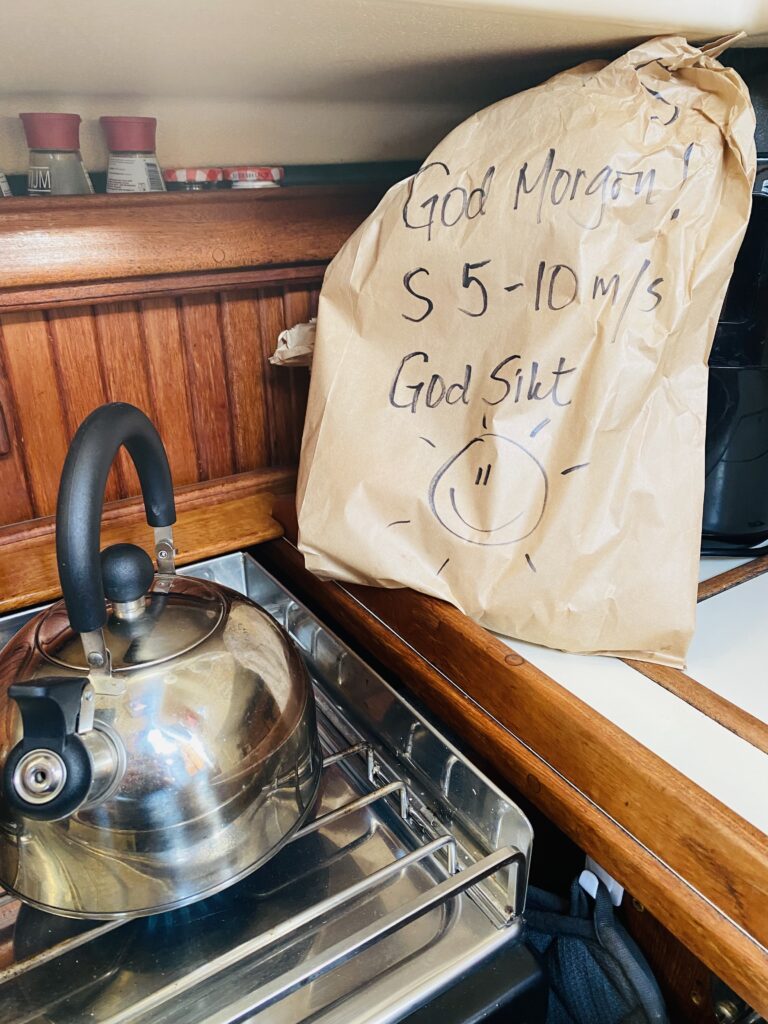
We (still) have a gas cooker and 2 gas bottles of 10 litres each on board. We dropped the idea of getting a diesel or paraffin cooker. From our point of view, the only sensible alternative would be (fully) electric cooking. But we are not equipped for that.
We always cook with gas when we do not have shore power, so while under way and at anchor. In the marina we use our IKEA induction hob. As we spend a lot of time in marinas in Scandinavia at the moment, one gas bottle lasts us almost 2 seasons. It is important to have the gas system checked regularly.
Cooling & provisions
Our fridge is quite large. But unfortunately, it does not have a freezer compartment. We have considered buying a freezer box from time to time, but we have always decided against it: too much power consumption, no ideal (sea-safe) place for it. We would love to freeze some food, for example herbs, vegetables, or bread, but for that the freezer box would need to be a certain size — and that simply does not fit.
Simple meals for rough seas
If we are under way overnight or for several days, which is more the exception than the rule, we prepare our hot evening meal the day before. Reheating is usually not a problem while under way. And breakfast in the form of muesli, a few sandwiches, or a snack in between is still manageable even in uncomfortable conditions. In our view, thick one-pot dishes with pasta or rice are particularly suitable. Nothing spills too easily when reheating them.

If the conditions are really rough, we only have snacks while under way. Our favourite snack: digestive biscuits, which we also call “sailing biscuits”. They are not overly sweet and they settle the stomach. They also go straight into a picnic bag in the cockpit before we cast off, together with drinks.
➡️ Our article about our favourite one-pot meals (coming soon!)
Storing provisions on board
We always keep a few basics on board in larger quantities:
- Long-life staple foods: rice, pasta, couscous, etc.
- Protein sources in dry form: lentils (red, green, and beluga lentils), soya protein (TVP).
- Tinned goods (ideally in Tetrapaks): chickpeas, beans, tomatoes.
- Basic ingredients that, together with a few fresh ingredients, let you whip up something tasty: coconut milk, cream, pesto, etc.
That is enough to keep you going for a few days. Not just on a boat.
So far, it has mainly been in Norway and the Åland Islands that there was no food shop nearby, not even a small one. We actually came back from the Lofoten with our provisions cupboard almost empty once.
A galley is more than cooking
Eating and cooking together matter a great deal to us. We both enjoy cooking and take turns. At first, we did not know whether our pantry on the small boat would really work for everyday life. But after a few years we can say: yes, it does. And it is what really completes our little floating home.
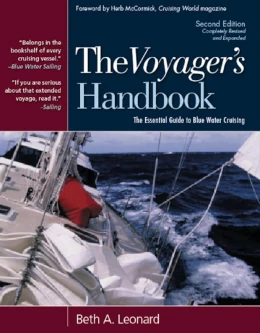
The experienced sailor and author Beth Leonard has put together a lot of useful material in her handbook, which has a permanent place in our on-board library. We have learned quite a lot from this book.