If you are travelling for a longer period, it is usually unavoidable that things break and you need replacements. We generally try to buy in local shops or, if that is not possible, use the “collect in store” option. We only order online with delivery if there is no way around it. And there is one main reason for that: without a proper postal address, it is not quite so easy.
Online orders and receiving parcels
Norway
For deliveries from Scandinavian online shops (there are not all that many purely Norwegian ones), you can often use a pickup point as the delivery address. Many chains with a smaller physical range offer “Hent i Butikk” (collect in store), for example books via Ark.no, electrical items from Kjel.no or household goods from Clas Ohlsen. If a delivery is sent with Postnoord, Posten (Bring), or UPS, delivery to a supermarket (Coop/Extra/Bunnpris) with a postal counter works smoothly. To collect it, you do not even need ID, just the email with the collection code (or better still the Postnord and Posten app) and a signature are enough. We only had problems with a delivery from abroad sent with Fedex. That one was returned, as Fedex apparently does not use the Norwegian pickup points.
As we are outside the EU single market here, customs duty is payable if you order from abroad. However, many sellers have what is known as a VOEC registration, so the customs charge is paid automatically. We ordered something from Finland, for example. The parcel was delivered quite normally and afterwards we had to fill in a customs form and provide the VOEC number. After that, everything was sorted. Normally, though, this all works automatically with VOEC-registered online shops. At www.skatteetaten.no you can check whether a shop is registered for VOEC.
Sweden
Parcel delivery to a kiosk (Boa) is possible (for example with delivery via Postnoord). When ordering, you simply enter the kiosk’s address and your name (with c/o). Amazon orders via amazon.se are even easier, as you can select the nearest Coop with a postal counter directly.
We did occasionally have small problems when collecting parcels with a German identity card. The booking system often seems to require the Swedish “personnummer”, but experienced staff can also deal with German ID. However, the ID document always had to be shown.
The Netherlands
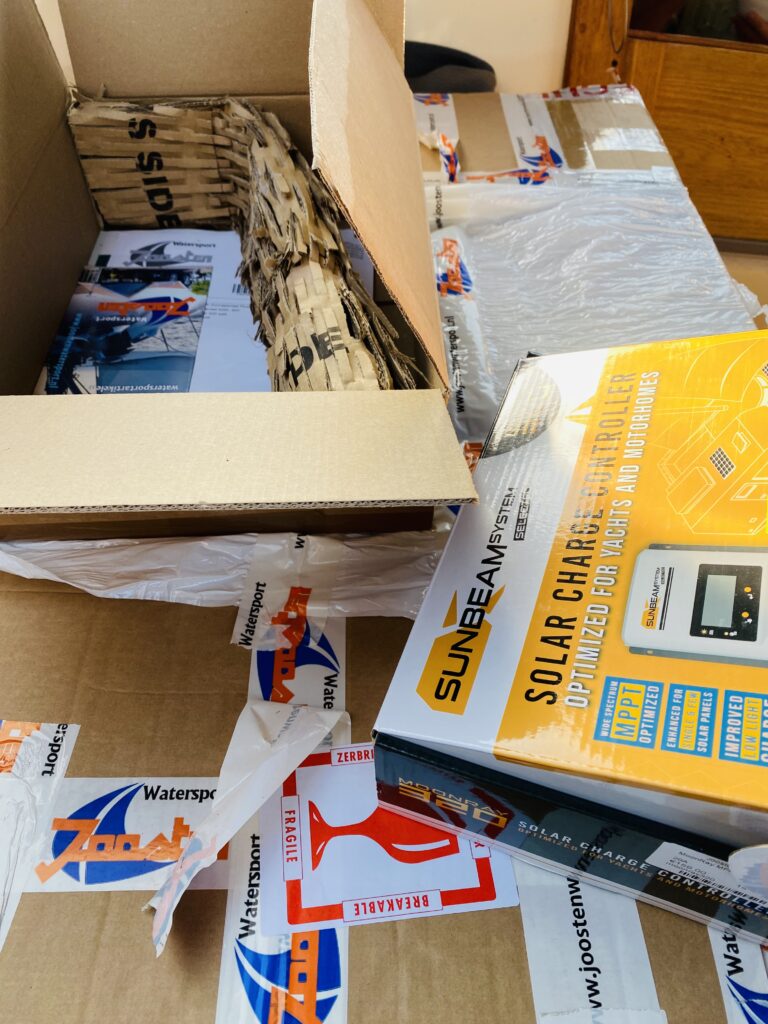
Here, parcel delivery was not really a problem. As a rule, you can have orders delivered to the usually permanently staffed harbour master’s office (again using c/o and the harbour office address) or redirected to a kiosk or newsagent with a postal counter (Post NL), just as in Germany. We asked briefly beforehand and got permission from the harbour master. Our friendly harbour master in Medemblik, where we had spent the winter, sometimes even brought the parcels to the boat.