
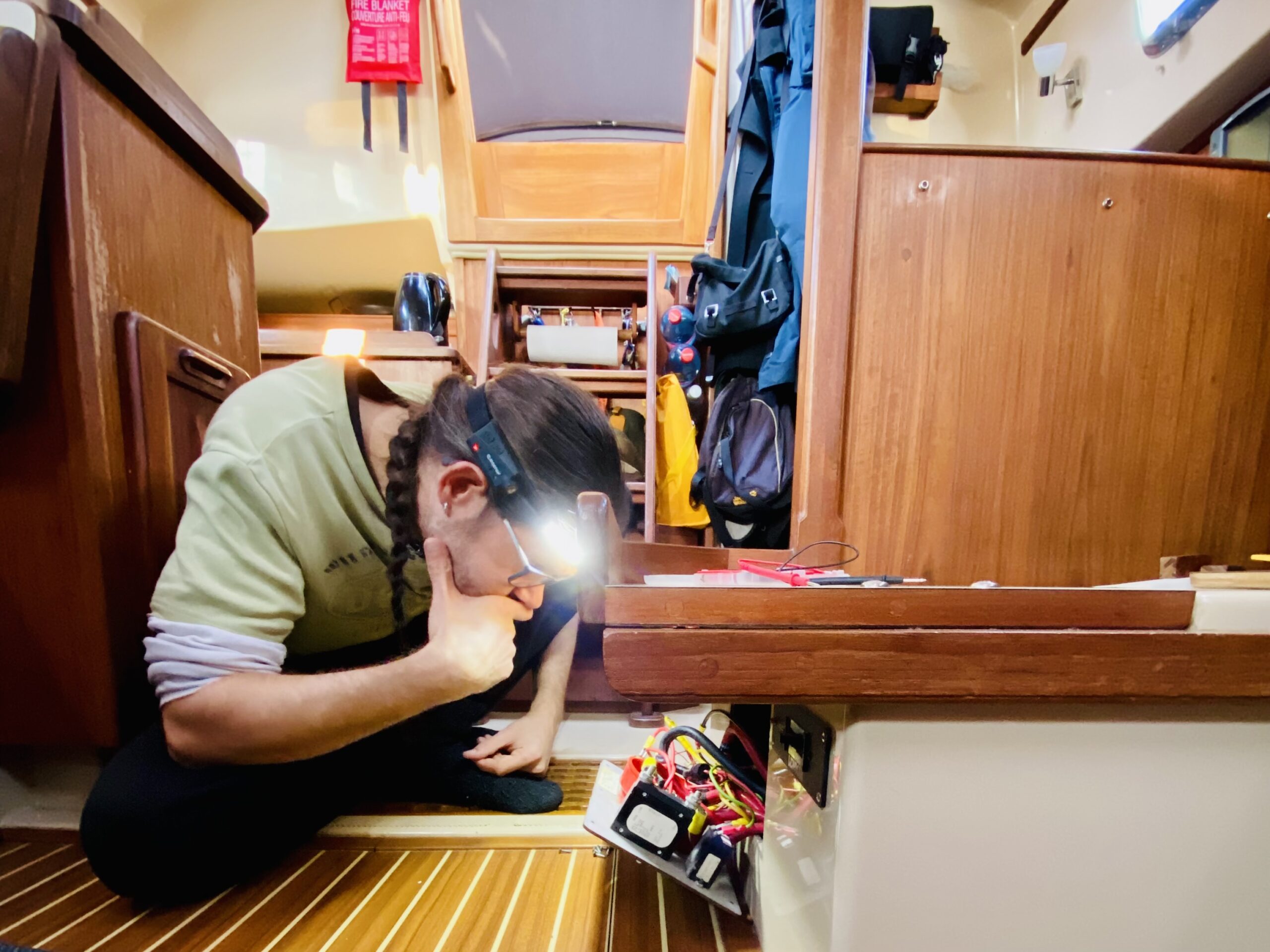
The wish to convert our existing AGM system to lithium or expand it to make ourselves more self-sufficient was at the top of our list after we moved on board. However, the options available initially seemed either very expensive or complicated. With a well-planned conversion, we still managed to achieve it quickly and fairly affordably.
➡️ Jump straight to the installation guide.
Energy supply on a bluewater/liveaboard boat
One of the biggest challenges when living on a boat is ensuring a reliable power supply. When staying in a marina or taking short day or weekend trips, this isn’t an issue, since shore power is usually available. But as soon as you spend several days at anchor or longer periods sailing, energy management becomes crucial.
Of course, one option would be to run the engine to charge the batteries (technically accumulators). But that’s not only environmentally unfriendly, it’s also impractical: it wastes diesel — which is limited on a smaller boat (we have 106 litres in the tank + 30 litres in jerrycans) — and it’s noisy and smelly. Running the engine for extended periods at anchor without any real load doesn’t do the engine any good either (keyword: glazed cylinders).
Converting AGM to lithium
The decision to enhance or upgrade our existing AGM system to increase our independence had already been made early on. We had planned to replace the AGM batteries once they no longer provided their rated output. As it happened, that came sooner and more unexpectedly than we thought.
Since I’m not an electrical engineer, I first did my homework and read up on the subject with the help of expert Nigel Calder, the authority on boat electrics. I can wholeheartedly recommend his book.
The old lead-acid system and its limitations
Our original setup consisted of three 12V AGM batteries.
- 2 x 100 Ah in parallel as the service bank
- 1 x 80 Ah as the starter battery for the engine and anchor windlass
The batteries were charged either via shore power or the alternator. When the engine was running, all three could be charged simultaneously. The parallel-connected service bank and the starter battery were separated by a diode isolator. However, these diodes have the drawback of a voltage drop (0.7V), which in the worst case means the batteries never reach full charge — substantially reducing their lifespan.
When connected to shore power, the Mastervolt ChargeMaster 12/25-3 handled the charging. We also had a small 50W solar panel mounted on the sliding hatch cover, but it no longer worked.

Our biggest power consumers are:
- Fridge
- Laptops
- Smartphones
- Router
While sailing, we drop the laptops but add:
- Instruments (log, depth sounder, wind gauge, etc.)
- Plotter and iPad for navigation
- VHF radio and AIS
- Autopilot
- possibly navigation lights
At anchor, or when working and needing the laptops, our consumption is about 35–40 Ah per day. Underway with the autopilot steering, that can easily double or even triple (80–120 Ah), depending on how much the autopilot works and whether navigation lights are needed.
Assuming AGM batteries shouldn’t be discharged beyond 50% (11.8V remaining voltage) to maintain their lifespan, we only had about 100 Ah usable capacity — and that’s assuming they charged fully. In ideal conditions, that means 24 hours at sea or two days at anchor. Not much, but adequate for our early needs, especially since we had already upgraded our solar setup (article coming soon), allowing us to stretch time between charging stops when the sun was out.
For our then-planned passage to Denmark, we expected two days and one night at sea, meaning we’d have needed to recharge underway using the engine. On top of that, the Victron battery monitor showed worrying values, and I suspected that at least one of the service batteries had significantly lost capacity.
The decision for lithium (LiFePO4)
The timing for the switch wasn’t ideal — we were in Terschelling, meaning every shipment came by ferry and took ages to arrive. Plus, the marina cost us €30 a day, which definitely factored into the decision: we had to find a quick and practical solution.
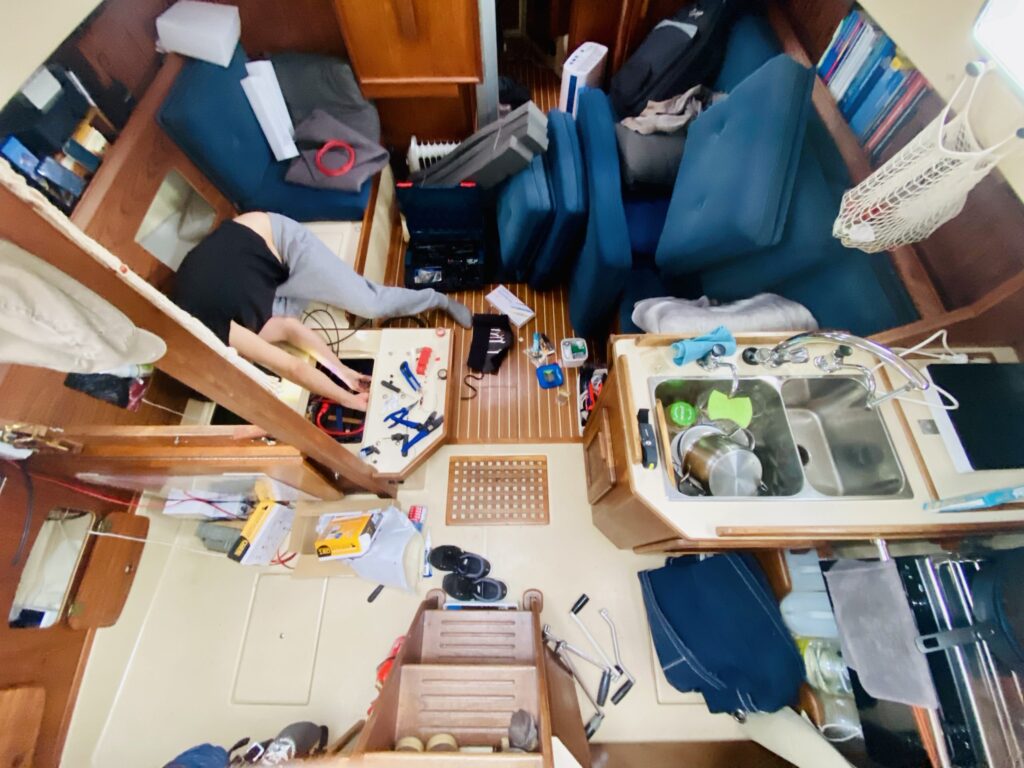
Three options were available:
- Stick with AGM and expand capacity
- Add lithium (LiFePO4) as a parallel hybrid extension
- Fully replace the AGM service bank with lithium (LiFePO4)
Sticking with AGM and expanding capacity
| Advantages | Disadvantages |
| Inexpensive option | Requires much more space |
| Easy to install | “Wasted” capacity since only 50% is usable |
We only considered this briefly. We simply don’t have the space on board for more AGM batteries. It also didn’t seem particularly “future-proof”, since we weren’t yet certain what our future power demands would be.
Lithium (LiFePO4) as a parallel hybrid extension
| Advantages | Disadvantages |
| Easy installation | Very expensive |
| Space-saving | Limited expandability or capacity |
The simple “drop-in” lithium option — such as BOS LE300 modules to expand existing lead-acid capacity — only came onto our radar during our research. We seriously considered it. But in the end, the high purchase cost and slightly oversize format for our battery compartment made us reconsider.
Full replacement of the AGM service bank with lithium (LiFePO4)
| Advantages | Disadvantages |
| Highest capacity | Expensive |
| Space-saving | Requires more installation effort |
Ultimately, we opted to fully replace our AGM service bank with lithium. This gave us the maximum possible “Ah” capacity within our available space. Although the upfront cost was high and the charging infrastructure needed adjusting, this setup is far more future-proof, especially if we ever extend capacity later on.
From AGM to lithium: Installation details
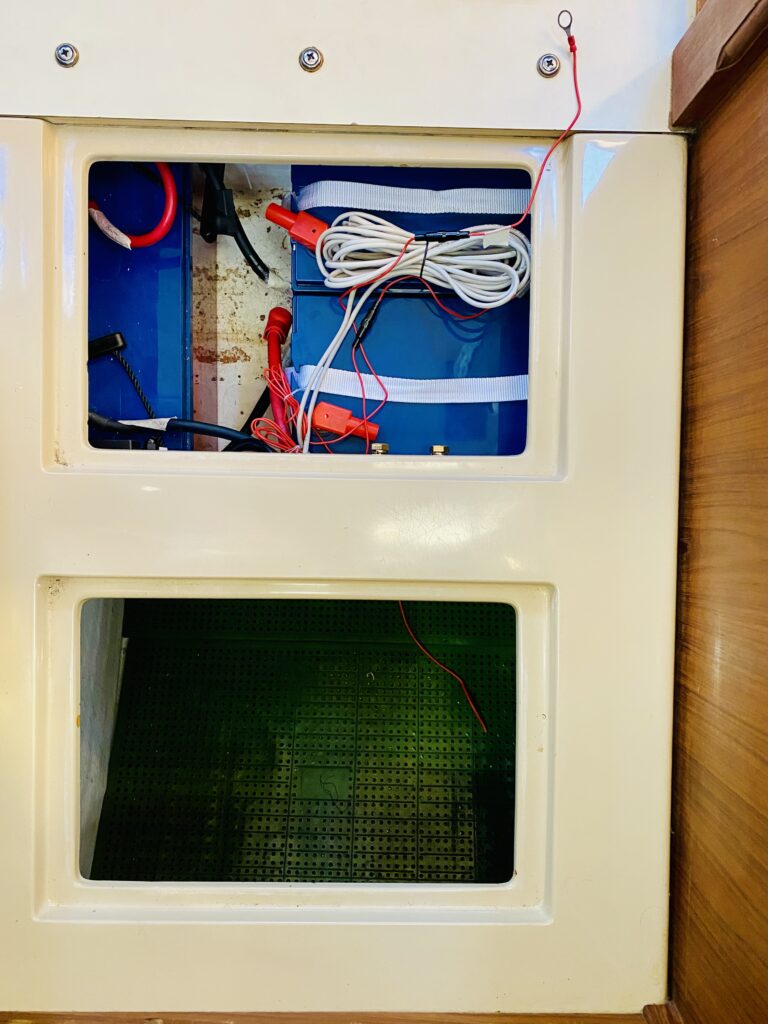
To keep things simple, we chose two VictronEnergy 12.8V Lithium SuperPack batteries: they have a built-in Battery Management System (BMS) and can be connected in parallel. So, we replaced 2 x 100 Ah AGM with 2 x 100 Ah lithium, which are smaller, weigh roughly one-third as much, and allow roughly 180 Ah of usable energy instead of about 100 Ah. The only catch: we needed to rethink and adapt the charging setup.
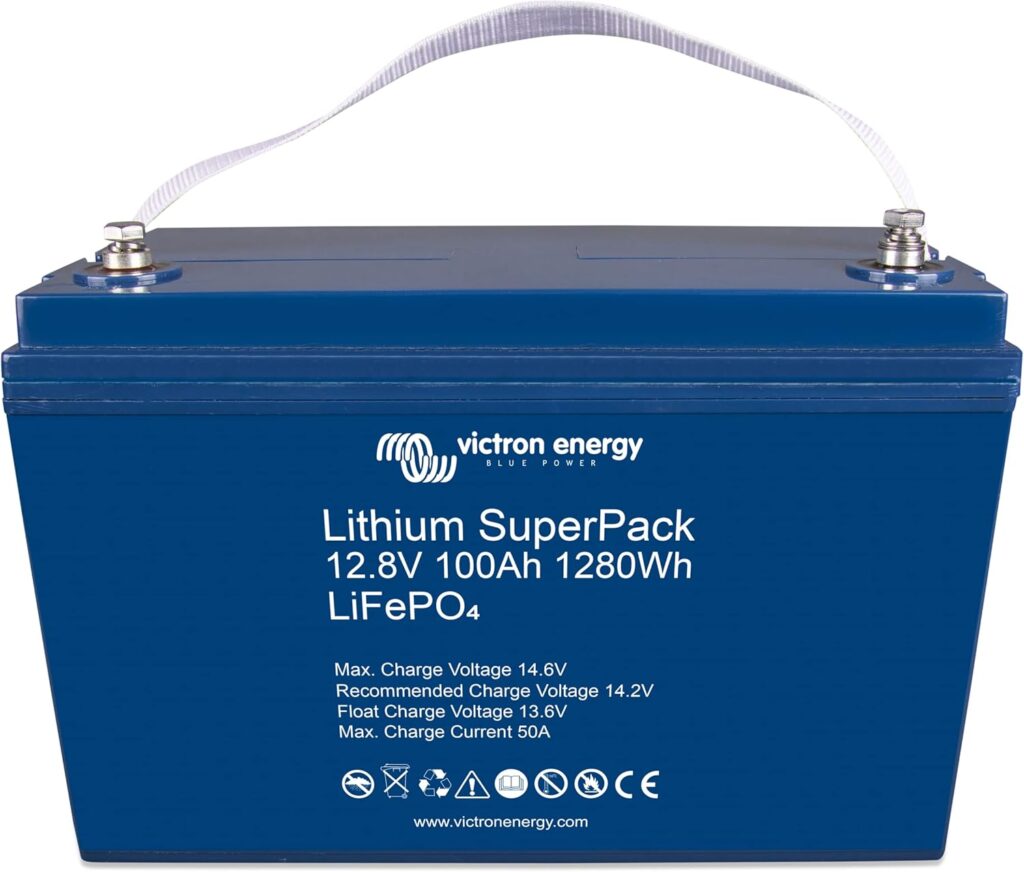
12.8V Lithium SuperPack from VictronEngery
We replaced our old AGMs with two LiFePO4 batteries. There are certainly cheaper options than Victron Energy, but we wanted top quality and perfectly matched components. All devices in the system are by Victron.
Having two different systems (lead-acid for starting and windlass, lithium for the service bank) complicates things slightly. After some planning, though, we found a simple solution: we sacrificed a bit of the lithium batteries’ “quick-charging” potential and kept our general system setup mostly intact.
Both the alternator and shore charger now charge the AGM starter battery. That way, our 50A alternator doesn’t need extra protection from overload or a sudden disconnect if the BMS cuts off the lithiums. This setup also allowed us to remove the diode separator, meaning the alternator’s full voltage now reaches the battery.
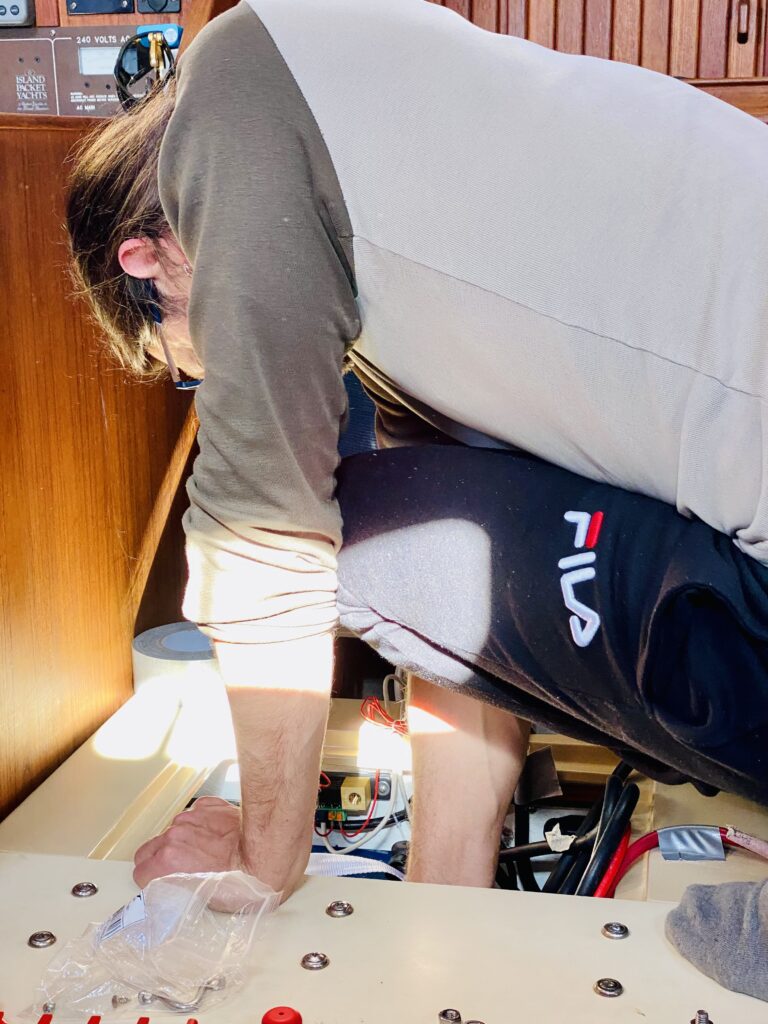
The lithium batteries are then charged via a DC-DC charger (Orion-Tr Smart 12/12-30) directly from the AGM starter battery as soon as it is itself being charged. Of course, this required installation and proper circuit protection.
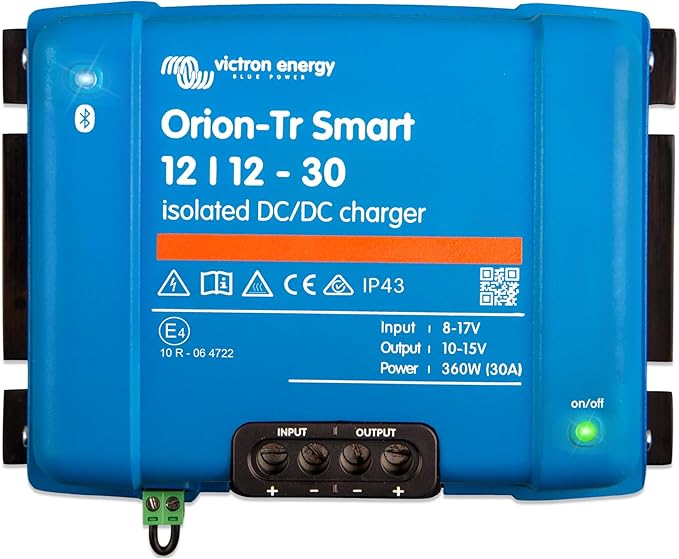
Orion-Tr Smart 12/12-30 charger
The heart of our charging system is the Orion-Tr Smart 12/12-30 from Victron Energy.
Additionally, we have two independent solar installations, each with its own solar charge controller, charging the lithium batteries directly.
Feel free to get in touch if you’d like to see our wiring diagram.
Costs
Our 2023 lithium battery installation costs:
| Item | Cost | Amazon link for current prices |
| 2 x 100 Ah VictronEnergy Lithium SuperPack | €1,950* | Compare prices |
| 1 x Victron Energy Orion Smart 12V|12V-30A Non-isolated | €280 | Compare prices |
| Installation materials (cables, fuses, busbars, etc.) | €250 | |
| Total | €2,480 |
Real-world experience
For our current boat life — half-day work sessions, coastal trips, 2–3 day passages, and multi-day anchoring in summer — the setup is perfectly adequate. We’ve never really hit the capacity limits. When we’re not cruising in northern latitudes (like in Norway in 2025), we’re even fully energy self-sufficient at anchor in summer.
Since we charge the lithium bank through the DC-DC charger, the charging current is limited to the 25A output of the charger (from both battery-to-battery and shore-to-battery charging). In daily use, this hardly matters because we often stop in harbours and usually stay overnight, giving the batteries plenty of time to recharge fully. Our standard 50A alternator is also perfectly capable of continuously supplying those 25A.
Looking ahead
Converting to lithium right from the start was absolutely the right move. Looking to the future, however, we’re already planning some upgrades to the boat that will significantly increase our power demand — beyond what our current solar and battery setup can handle. On our wish list:
- Electric outboard
- Watermaker/desalinator
- Multi-day offshore voyages
- Electric cooking
Leaving the electric cooking aside — that’s not top priority — these additions would still require at least doubling our current battery capacity. Increasing solar capacity would then also make sense.
Affiliate notice: This page contains affiliate links. If you make a purchase through these links, we receive a small commission at no extra cost to you. Thank you for your support!