
When we decided to live permanently on our sailboat, one of the central questions was: Can we work remotely from the boat and reliably earn money on the move – without a fixed office, without stable infrastructure, but with plenty of sea all around? From the start, we had no ambitions to build social media channels, where the expected income usually doesn’t match the effort.
Our solution: remote work from the sailboat
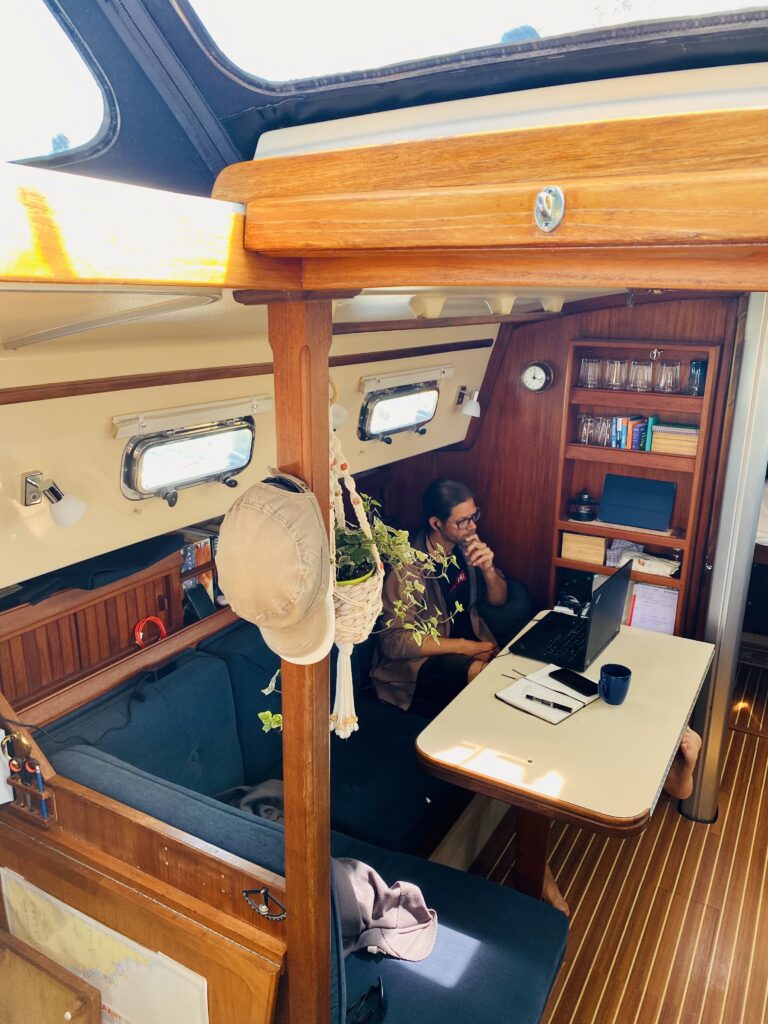
For Tommy, it was quickly clear – remote work on the boat wasn’t a problem. He has been self-employed since university and has always worked from home. Tommy is a software developer – sometimes freelance, sometimes employed. He occasionally works on client projects, but otherwise he works daily for his employer.
Working on board – how we earn money on the move
For me, the answer was not so straightforward. During the pandemic, working from home in our company was no longer a utopia. But such an unusual remote-work setup in a medium-sized company? I was already thinking about plan B. Yet, contrary to my expectations, they agreed to try the experiment. So I have now been working as a product manager for four years – with project responsibility, team meetings, and editorial coordination.
Technical requirements on board
Absolutely essential for us is a stable internet connection and a laptop. We don’t need anything else to work remotely from the boat. We consciously decided against Starlink for our internet connection. And that was before Elon Musk became unbearable. We ran the numbers and concluded: As long as we are in Europe and mobile internet works smoothly and cheaply across borders thanks to European roaming, we don’t need satellite Wi-Fi. In our cost breakdown you can see that prepaid internet via SIM card (250 GB, €38, Telenor) – at least for our usage near the coast and in terms of traffic – beats Starlink (unlimited, €89, travel). With 250 GB, even streaming is no problem. If needed, we can top up for the same price.
When we’re in harbour, power is no issue. At anchor, with enough sunshine, we have sufficient electricity for a few days or even unlimited power via our solar panels. To set up our boat office optimally, we also installed a few extras.
Our favourite workspaces are in our saloon at the table. I also like sitting in the cockpit, and for meetings I go to the foredeck so as not to disturb Tommy too much.
Time management & routines
As in the early days of working from home during the pandemic, maintaining a healthy separation between work and leisure is important for the boat office. We have now gotten quite good at this. When laptops are closed and put away, it’s the end of the working day. To avoid unnecessary stress, we always head to a harbour or a sheltered anchorage during storms. Fortunately, this isn’t a problem in central and northern Europe. There’s always an affordable berth or a free bay. And if we’re unlucky and end up in a harbour with a lot of swell, like in Amsterdam in our first year, everything just has to be secured well.
Challenges of working on the move
The biggest challenge for me is the lack of direct contact with my colleagues. Sometimes I miss shared lunch breaks or the after-work pint. When meetings are scheduled during the day, we quickly switch to work mode. Private chats often take a back seat. But with my favourite colleagues, we occasionally have digital lunch breaks. And even if sitting together at the best falafel shop in Cologne would be far better, the Teams lunch break is always one of my highlights.
Our tips for beginners
From our experience, if possible, earning from your regular job is usually the most reliable and effective from day one. Yes, there are also YouTubers who make a good living from their sailing channels. But even here, you need to invest significant time and equipment, and it usually takes a while before it pays off. Calculating an hourly rate, it’s (from our point of view) not economical. You are also dependent on the platform and its algorithm. Our only affiliate site, which ran well for a long time and generated a few euros regularly, is now on hold because the programme no longer rewards the leads.
It’s therefore always good if such income sources aren’t the only ones. Investment returns can only contribute partially, as you don’t want to be forced to sell shares when the market is down. Well-planned withdrawals and regular dividends, on the other hand, are a good supplement if, for example, a freelancer does not want to take on client projects during the summer.
Which jobs are suitable for remote work on the boat?
In principle, you can do anything that can also be done from a home office in “normal life” and doesn’t require direct client contact:
- Graphic and web design
- Software development
- Product and project management
- Editing and copywriting
We have also met people who manage construction projects remotely, teach online yoga classes, or offer language courses. As long as you do it for clients or employers in Germany, local authorities generally don’t mind. At least in the EU or countries such as the UK and Norway. We have already checked the legal situation there.
Conclusion: working on board – dream or stress?
Would we do it again? Definitely yes! Without a doubt. It’s simply wonderful to close the laptop after work and sail to the next anchorage or jump into the water. A 9-to-5 office job and permanent city life would be unthinkable for us. But also: no 40-hour week on the boat. We both work about 25 hours per week. That’s more than enough to cover our regular expenses and continue investing in financial freedom (long-term ETFs and day trading).