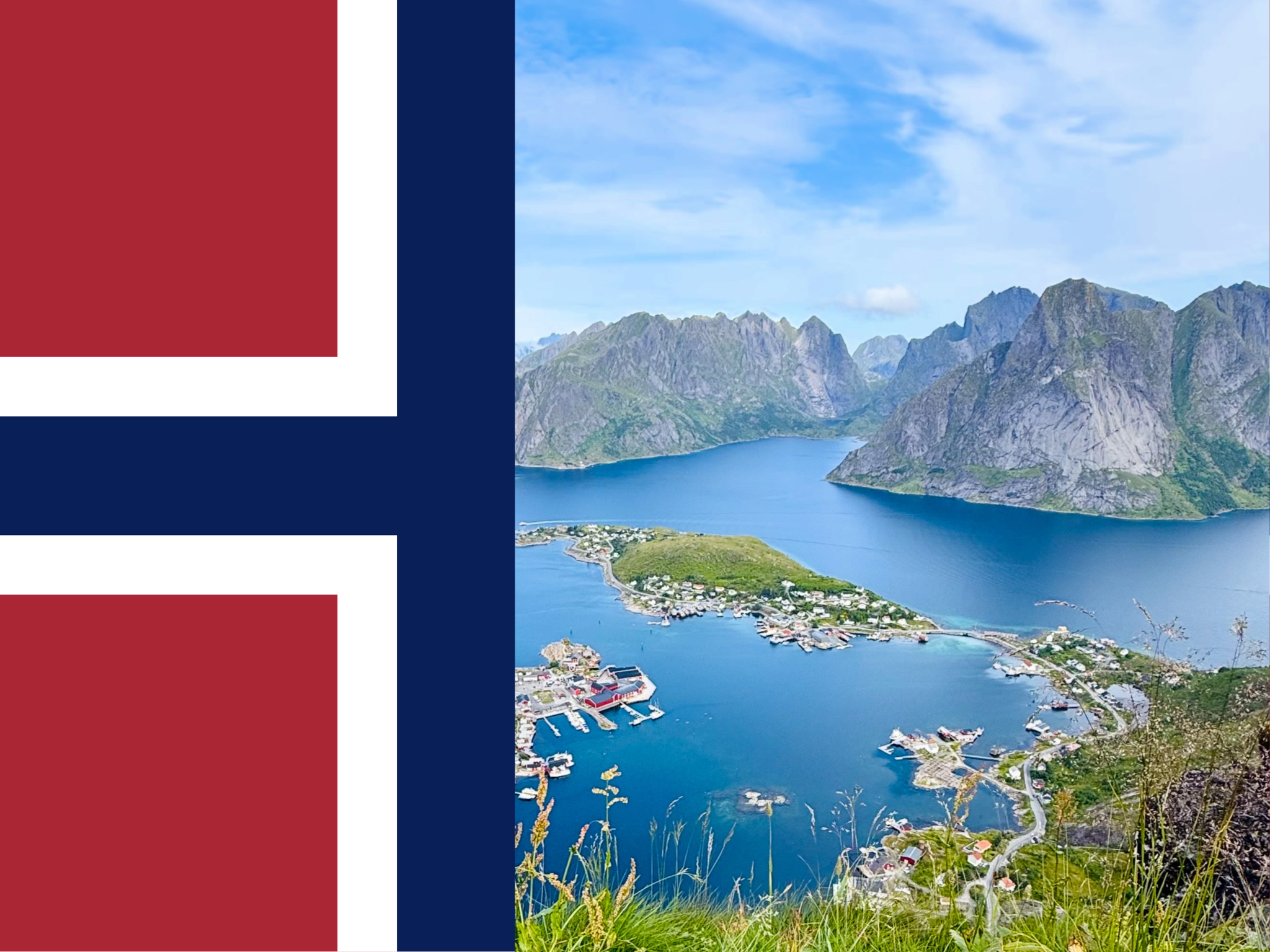
Our trip along the Norwegian coast
- five months
- 1,643 nautical miles
- 62 harbours
- 15 natural harbours and anchorages
Norway had been one of our dream destinations for a long time. Even before we started sailing, I was already completely in love with its wild and rugged landscape. Now that we knew our boat well and had gained a bit of confidence in our sailing skills, we dared to cross the Skagerrak. We sailed all the way to the Lofoten Islands and experienced an absolutely magical sailing summer along the Helgeland coast and in the Vestfjord.

Harbours & marinas
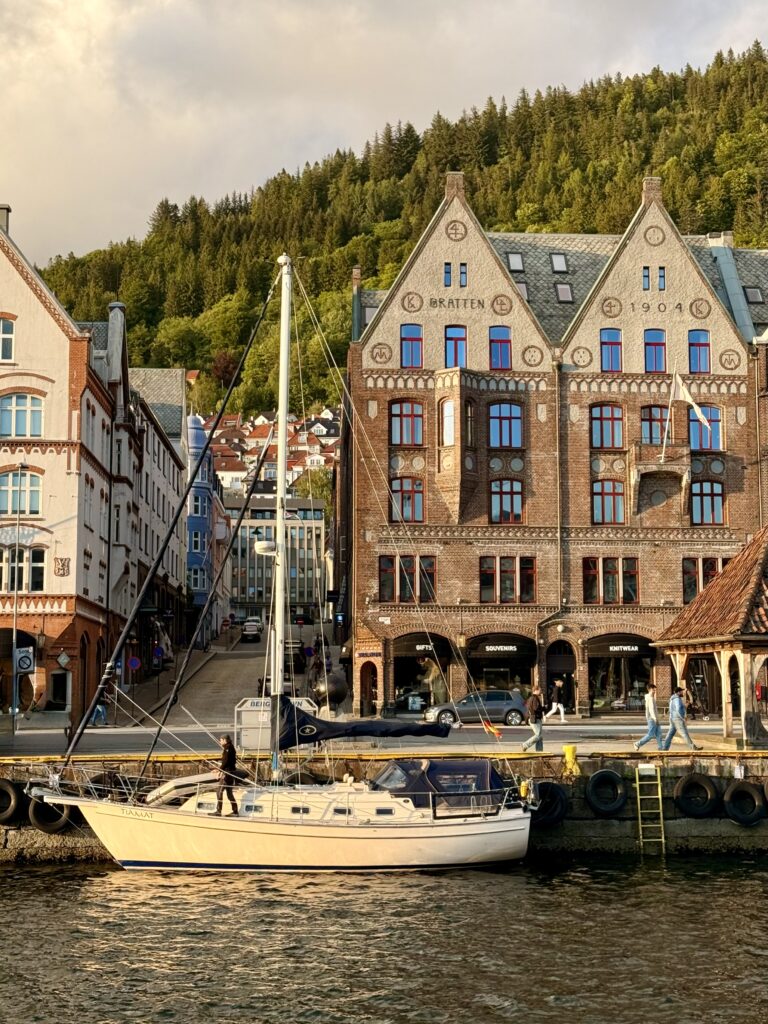
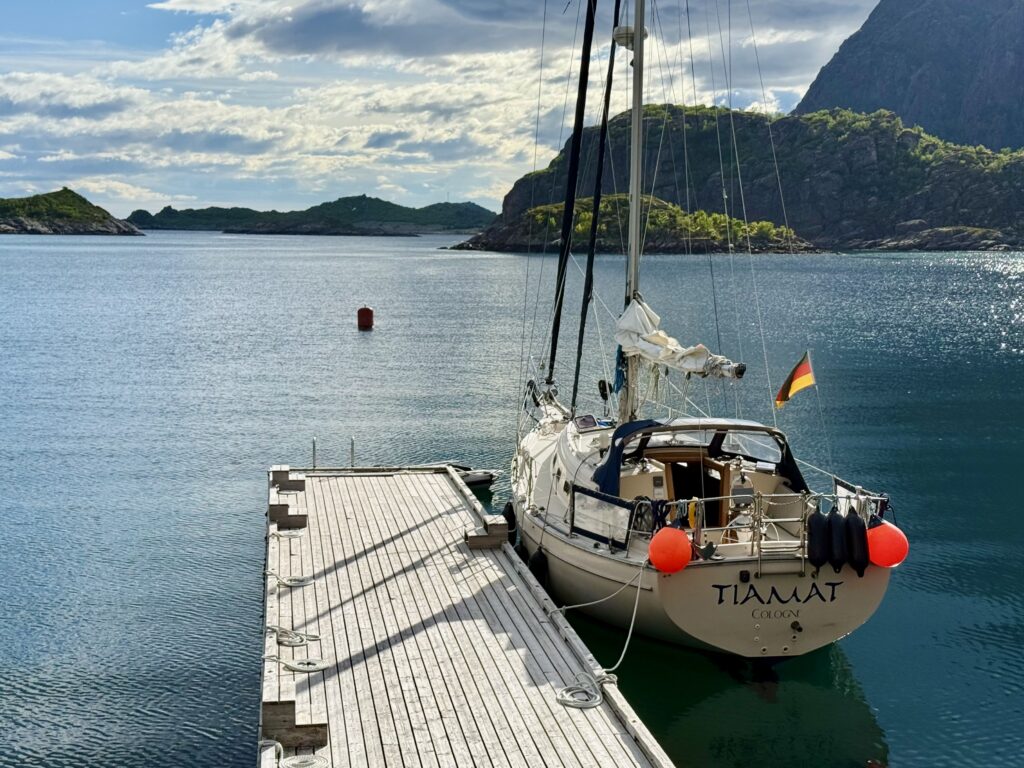
Along the west coast, you’ll mainly find small harbours. Larger city harbours are the exception. Big, commercially operated marinas are practically non-existent here. In the south, harbours tend to be a bit larger and offer several guest berths, while in the north there were often only two to five guest spots available. On top of that, the number of visiting boats over 40 ft has increased, and Norwegians often occupy the harbours with huge motor yachts. As a result, things fill up quickly. Never before have we had to leave an overcrowded harbour and look for an alternative as often as we did here.
Unlike in Sweden, sailing takes place year-round along Norway’s west coast – or so we were told along the way. At least the locals are not put off by darkness and cold. Often it’s not a leisure activity at all, but simply the fastest way to get from A to B. Many harbours therefore offer at least basic facilities (electricity and, if possible, water) even in autumn and winter. In summer, from mid-June onwards, things get busier; by mid-August, the holiday season is basically over. At most guest pontoons, you moor alongside. Harbours usually offer sufficient depth and space for manoeuvring.

Harbour fees and payment
Harbour fees are – unlike many other things in Norway – relatively affordable. In fact, our months here were, on average, the cheapest of our entire journey so far when it came to mooring fees. We usually paid around 200 NOK for our 35 ft boat, which is roughly €18 (showers or laundry are often extra). Prices are generally the same in low and shoulder season as they are in high season.
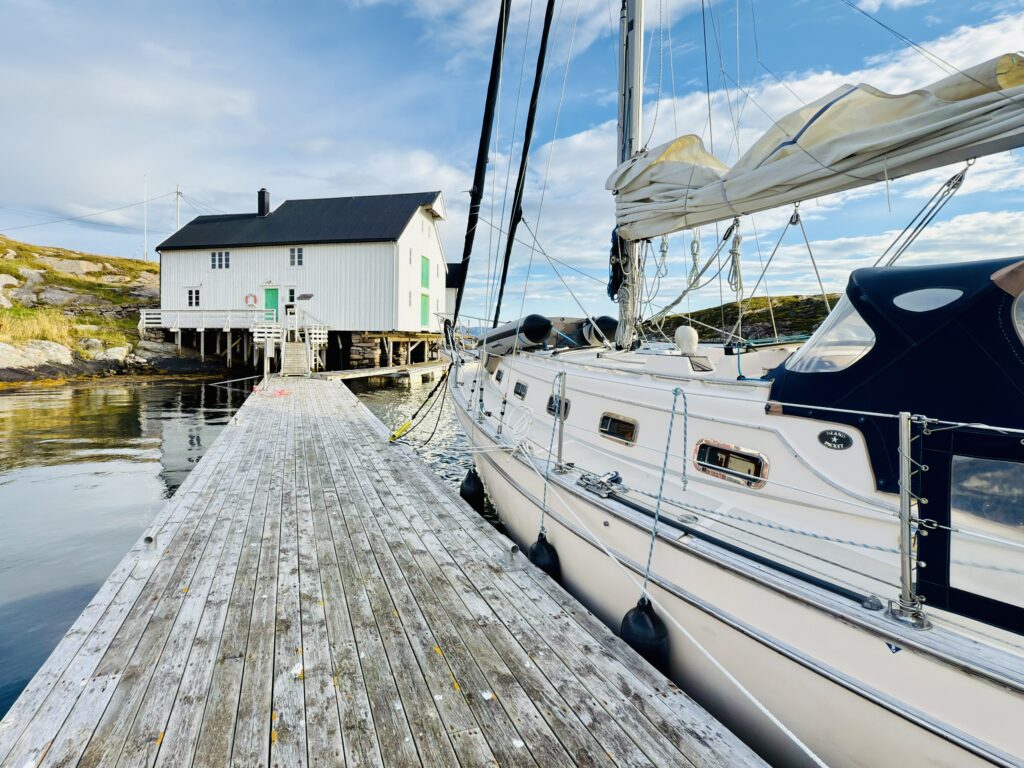
Only in the Lofoten were prices significantly higher, for example around €36 in Reine. And even there, the service was minimal – basically just water and electricity. What annoyed us most, however, was the fact that in many sailing club harbours, foreign visitors could only pay cash. That wouldn’t be too bad if there weren’t so few cash machines left in Norway. In the north, we only found one in Bodø. We ended up staying three days in Reine and completely ran out of cash. Often, payment via GoMarina or Havneweb is also possible, which makes things easier. When asked, harbour contacts also sometimes provided bank details for a transfer.
Information on harbours and marinas for sailing in Norway
- Norway (Imray): A truly helpful and comprehensive book covering the entire coast all the way up to Svalbard and Jan Mayen. We’ll definitely keep it for our second trip to Norway.
- Harbourmaps Harbourmaps.com A useful website with lots of harbours and assessments of wind protection. Practical filter functions. Unfortunately, it can’t be used for free for long. The subscription costs €25 per year.
Natural harbours & anchorages
In southern Norway and along the south-west coast, we didn’t anchor much at first, as the weather was still cold and unsettled and we preferred staying on shore power with heating. Many potential anchorages along the way were also too deep for our setup (55 m of chain). Only from Rørvik onwards did we start anchoring regularly and fully enjoy the glorious summer weather.
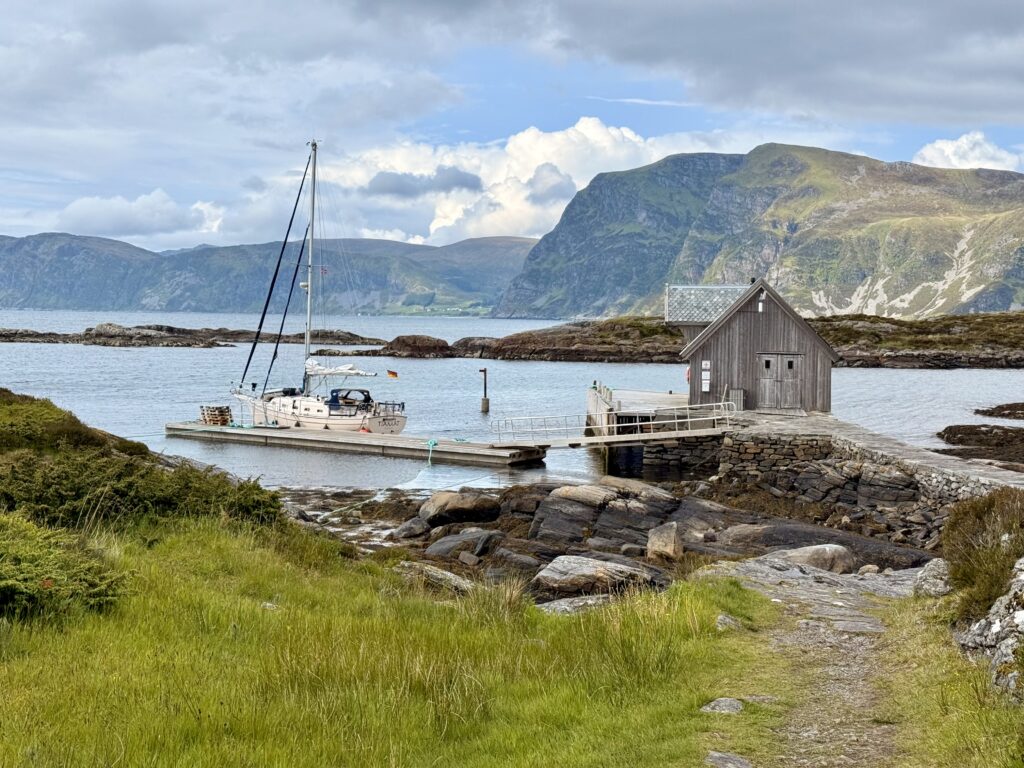
Unlike in Sweden, it’s common in Norway to pay a small contribution even for using natural harbours. Usually between 100 and 200 NOK, so a maximum of about €18 (2025). Payment is via VIPPS (not available to foreigners), cash in an envelope, or bank transfer. These places are maintained with so much care and love that it felt more than fair to us.
Weather & sea
The European Arctic Ocean treated us to comparatively mild conditions in spring and summer. From June to early August, wind strengths were generally pleasant. Most of the time, however, the wind was either straight on the nose or directly from behind when sailing close to the coast. More than once, we had light winds that would theoretically have been sail-able, but in practice we still had to motor, because old, high swell made slow sailing unbearable. In September and October 2025, the first autumn storms and lots of rain made progress more difficult.

We mainly used Windy, usually in combination with the local Norwegian forecast from Yr, which gives a fairly accurate impression of the weather for the next 24 to 48 hours. Barentswatch also provided very good information on currents and wave conditions.
Life on board in Norway
Money
In 2025, the Norwegian krone (NOK) was worth around 0.085 EUR. Throughout our stay in Norway, we regularly had to withdraw cash, as tourists are often only able to pay for guest berths that way. The only cashless alternative was usually bank transfer, which can quickly become expensive outside the EU. We therefore used the Wise payment service, where a transfer costs just €1–2.
Grocery shopping

There are several larger supermarket chains (Meny, REMA 1000, Extra) as well as smaller grocery shops (Joker). The selection is more or less the same everywhere. Usually, there are only a few brands per product, mostly Norwegian ones. Prices are even higher than in Sweden. The choice of vegetarian and vegan products is very limited. Plant milk is readily available, yoghurt only comes in fruit flavours. Tofu is available in most REMA 1000 and Coop stores (usually near the cheese). There are also a few meat and cheese alternatives. Fruit and vegetables are generally good, but become more limited and more expensive further north.
Beer is available in supermarkets throughout Norway, but only on weekdays and during certain hours. Stronger alcohol is sold exclusively at Vinmonopolet, a state-owned retailer. We were surprised to learn that no alcohol is sold at all on Sundays, public holidays, or in the evening. You’re allowed to look at the beer, though. Probably good for both health and wallet.
Mobile internet & Wi-Fi
Network coverage is excellent – even miles offshore and deep inside the fjords. Norwegian prepaid mobile plans, however, are hopelessly expensive. We therefore continued using our Swedish SIM card for the onboard router with a prepaid option (Telenor 250 GB for around €36).
Laundry
So far, we’ve only had a few opportunities to do laundry for free, including in Stocksund (Stokkøya), Kristiansund and Sandnessjøen. Otherwise, a fee of around 50 NOK is usually charged for washing, and the same again for the dryer.
Waste water & diesel
We saw far fewer pump-out stations for black water tanks in Norway than in Sweden. As we don’t need them due to our composting toilet, this wasn’t an issue for us. Only a few harbours offer them, and the further north you go, the rarer they become. You’re most likely to find pump-out stations in the fjords. Compared to Sweden, Norway’s regulations on discharging waste water into the sea are relatively relaxed. Apart from the Oslofjord, black water may be discharged at a distance of 300 metres from the coast. When in doubt, it’s best to follow MARPOL regulations (Annex IV).
During our trip, diesel prices were around 13–17 NOK per litre, roughly €1.20. Fuel is sold as tax-free, dyed diesel (avgiftsfri/anleggdiesel). We keep the receipts in case questions arise in another country.
Formalities
This was our first time in a non-EU country. We therefore informed ourselves in advance and during our stay (2025/26) about formalities such as residence permits, visas and customs. EU citizens can travel to Norway with just an ID card and without a visa. However, you must leave after a maximum of 90 days, although you can re-enter immediately afterwards. I contacted the UDI and learned that leaving the 12-mile zone (for example on a passage to Svalbard) counts as an exit. We didn’t want to go there, and heading 20 miles offshore just for the sake of it didn’t appeal either. So we took a trip from Trondheim to Sweden instead (Storlien, a 90-minute train ride, including an ICA shopping run). For longer stays, it’s also possible to register with the police and apply for an extended residence permit. Shouldn’t be a problem. Anyone overwintering or storing their boat here must either keep an eye on it (maximum six-week absence) or apply with customs, otherwise VAT may become payable. Here’s the customs information page with the application in English.
We were inspected by customs in Mandal in 2025. We were asked about our plans and received some good tips for our journey. As we had no alcohol on board over the allowance – and they believed us – it was all very relaxed. Remember that you’re not allowed to bring much alcohol into Norway, and no potatoes at all. Here’s more information from customs.
Our favourite harbours and anchorages in Norway
Sailing in Norway: our tips for worthwhile destinations. On our relatively short trip, these harbours and anchorages in western Norway were our personal highlights.
Harbours
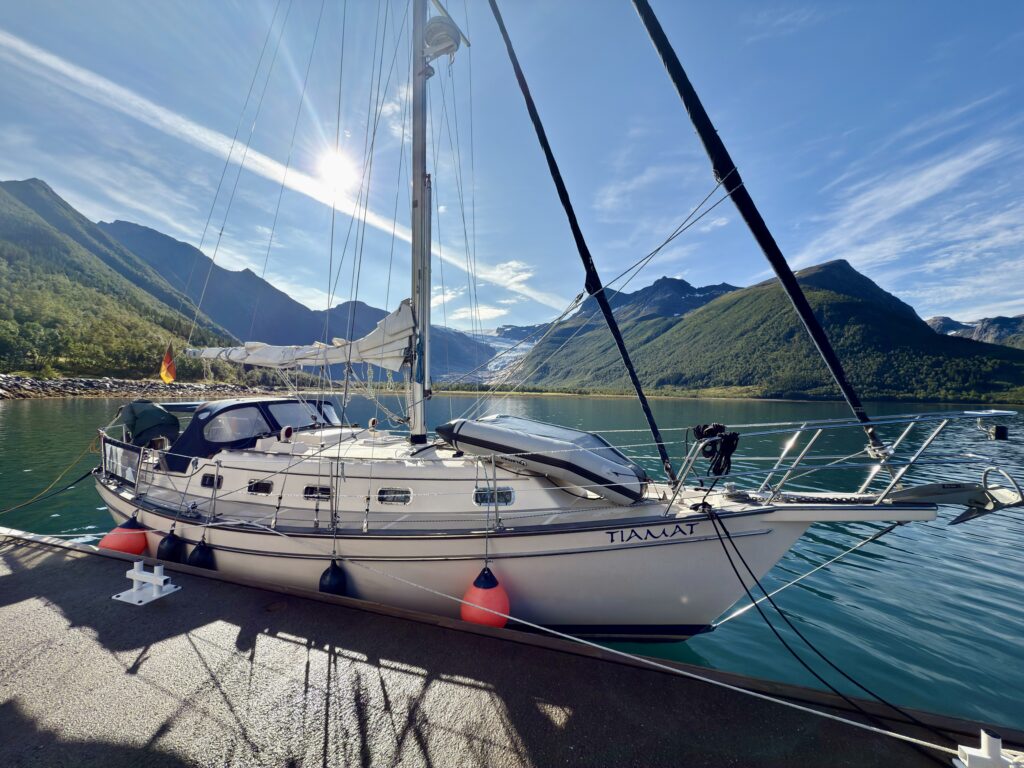
- Sæbø (Hjørundfjord) One of our highlights was our first fjord and the small harbour by the local hotel. Absolutely unique nature, the village framed by mountains. The fjord isn’t very long and, due to a sandbank, cannot be entered by the Hurtigruten. Simply wonderful.
- Lovund (Helgeland coast) A relatively new harbour on the small island of Lovund. Not cheap, but well located and very well maintained. Even though the island is small, there’s plenty to do. It has therefore become one of our absolute favourite places.

Natural harbours & anchorages
- Straumøyan (065° 33.283′ N / 012° 14.369′ E) Two pontoons and a few mooring buoys in completely unspoilt nature. There are barbecue areas on the pontoon and ashore. The barbecue hut itself is reserved for sailing club members.
- Torget (065° 24.841′ N / 012° 06.874′ E) A beautiful anchorage with good access ashore by dinghy via the guest pontoon. Not far from Torghatten, the famous mountain with a hole through it.
- Hauklandsbukta (068° 11.725′ N / 013° 31.293′ E) We spent one night at one of the most iconic beaches in the Lofoten Islands: Haukelandstranda (Haukeland Beach). Fine white sand, crystal-clear turquoise water, surrounded by mountains. The holding is very good, with depths between 5 and 8 metres. The bay is open to the west, so there is always some swell, even in light winds.
- Villa (064° 32.712′ N / 010° 42.376′ E) A newly built pontoon from 2025 on a small, beautiful island. Perfect for hiking, climbing the hill, or walking out to the lighthouse. There are barbecue areas and a toilet. Payment is 200 NOK via bank transfer.
