Discover the best sailing Denmark tips for your cruise planning! Sailing areas, marinas, anchorages & practical advice for unforgettable sailing adventures in Denmark’s coastal waters.
Our trip through Denmark
- two months
- 230 nautical miles
- 7 harbours
- 5 anchorages
Harbours & marinas
Along our route, we stayed in a few large marinas, such as Kerteminde, and in tiny harbours like Ballen on Samsø. Although we often had difficulty manoeuvring our long-keel boat in these small harbours, we preferred them to the large ones. The sailing season in Denmark begins in May, but we always found a berth without problems. Most harbours have boxes with stern posts, similar to the Netherlands. Unlike there, however, there was usually no harbour master on site.
The Danish berth system
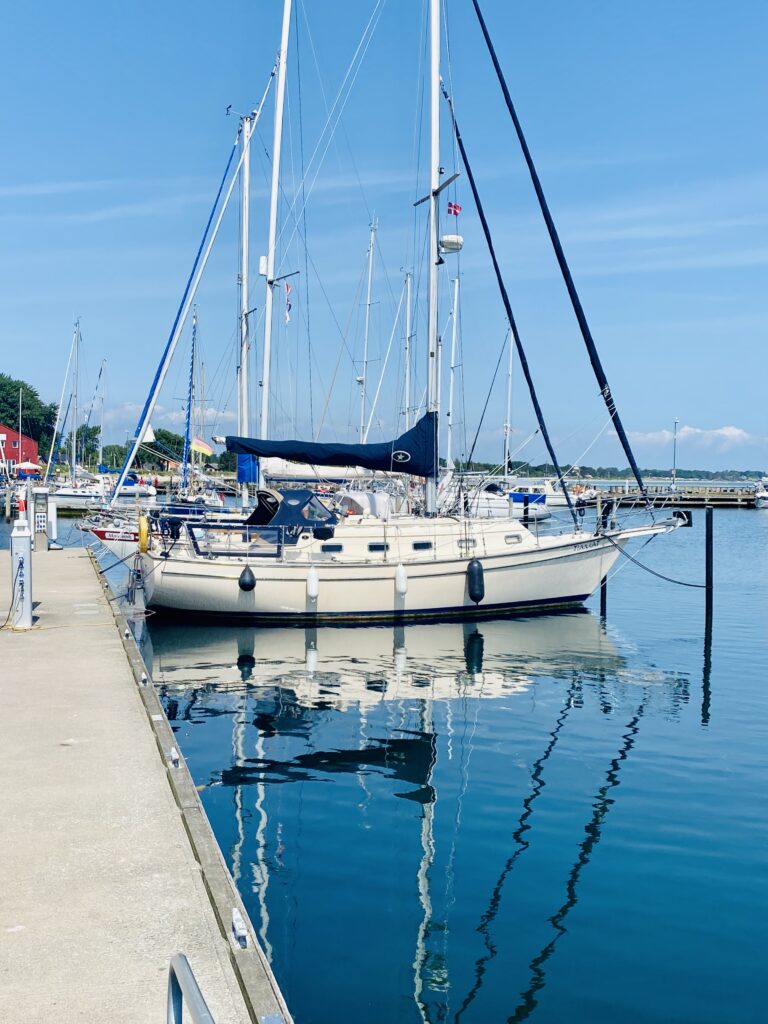
When you arrive, you simply find yourself a berth with a green sign. Danish boat owners who leave their home harbour overnight must – as a Dane explained to us – switch the signs at the berth from red to green. If you’re lying in a green box as a guest, you can stay there as long as you like, even if the owner returns. It happened to us once that an owner returned and very politely asked us to find another free berth. You naturally do that gladly then.
At the beginning, we found it a bit stressful in the marinas in Denmark. Websites often provide no information about the berths. Once you’re there, the guessing game about a suitable berth begins. The goal is to find a box with a green sign in the right size in an unfamiliar harbour. Because there’s usually no information about the size of the berths, you can only estimate length and width. If you’re lucky, the width is marked on the pontoon. You don’t really want to do this at night. Harbour fees fluctuate during the season between 25 and 35 EUR for 35 feet. Payment is usually made at a machine or online (GoMarina, TallyWeb, etc.). In some harbours (e.g. Ærøskøbing), you get one day free for a longer stay of a week.
Information about harbours and marinas for sailing in Denmark
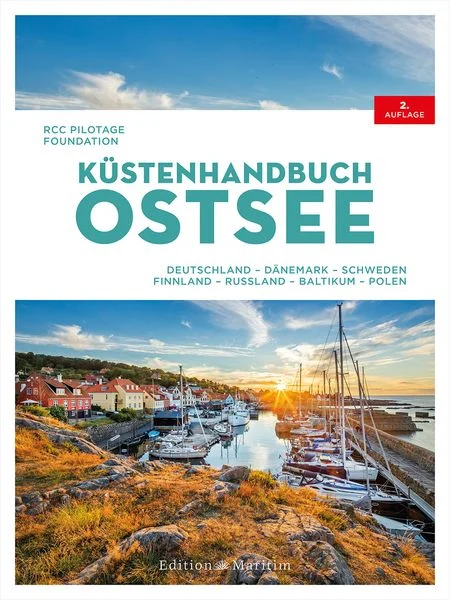
- Baltic Sea coastal handbook: The book is a brilliant introduction to all nine Baltic Sea coastal states. The chapters on Denmark, Germany and Sweden also describe the North Sea coast. We have it in English from Imray, but now there’s also a current German translation available.
- Sejlerens Magazin with basic information about marinas in Denmark, available in most harbours. There’s also a website or app (sejlerens.com).
- The harbour guide havneguide.dk offers helpful information about harbour services and costs, including a detailed map, contact numbers and fees. Combined with a practical search function, the site is one of the best harbour guides we’ve found so far.
Anchorages
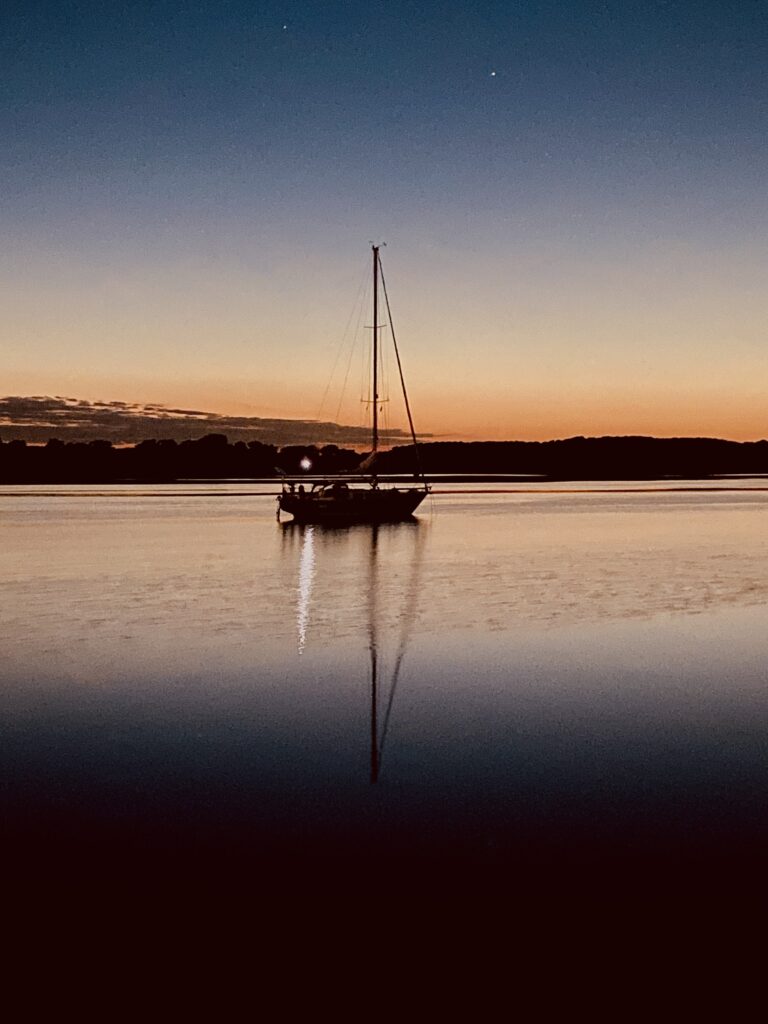
Denmark has many good anchorages to offer on the east coast. The water isn’t too deep and there’s usually good sandy bottom. Additionally, the two Danish sailing clubs offer buoys. But only those of Danske Tursejlere (often yellow or white with the inscription DT) can be freely used by anyone. With a boat weighing less than 15 tonnes, you can stay at these buoys for 24 hours. The others are red and belong to Dansk Sejlunion. These are for members only.
On the Danske Tursejlere website dansketursejlere.dk you’ll find a map with all the buoy positions. An app is also available.
Weather & sea
We found late spring and early summer in Denmark very mild and pleasant. The temperatures were perfect and there were only a few rainy days. The sea in the southern Funen archipelago seemed lovely most of the time, with little swell. But on our journey, it often alternated between absolute calm and suddenly quite a lot of wind in a very short time.
We mostly used Windy in combination with the local Danish weather forecast from DMI (dmi.dk), which gives a relatively accurate impression of the weather conditions for the next 24 to 48 hours. If you’re sailing in the Øresund or the Great Belt, it’s advisable to keep an eye on the currents there. We checked DMI for the direction and strength of the currents, which can reach 4 to 5 knots in the sound between Helsingborg and Helsingør.
Life on board in Denmark
Money
The Danish krone (Dansk krona, DEK) was worth about 0.13 EUR or 0.15 USD in summer 2023. During our entire stay in Denmark, we were only asked to pay cash once at a small restaurant. Otherwise, we paid for everything with a credit card; even the smallest harbour has a machine for payments. But if you want to buy what the nice people are selling in front of their houses (fruit, vegetables, second-hand stuff), you need cash or the payment app Mobile Pay, which, however, you can only use as a Danish resident.
Food shopping
Almost every town has supermarkets (Netto, Føtex, Lidl) or at least small grocery shops, but their prices are quite high compared to the Netherlands or Germany and even to Sweden. Unusual for Scandinavia: in Denmark, you can buy alcoholic beverages in supermarkets.
Mobile internet and WiFi
Although network coverage is perfect and available even miles off the coast, the WiFi provided in harbours or towns is almost unusable, even in the off-season. Therefore, we bought a mobile SIM card from Lebara in a Netto supermarket for our router on board, with a prepaid option for 100 GB for 99 DEK.
Laundry
We only did laundry once during our stay in Denmark, so we can’t really say what the prices are like. At the time, we paid about 5 EUR for washing machine and dryer. But we also didn’t find any marina where washing time was included in the harbour fees.
Pump-out & diesel
Many Danish marinas have a pump-out facility for black water tanks.
Our favourite harbours and anchorages in Denmark
Sailing in Denmark: our tips for worthwhile destinations. On our short trip, these harbours and anchorages in Denmark were our highlights.
Marinas or harbours
- Ballen on Samsø was our absolute favourite place. The lively harbour was surrounded by a small village and a beautiful beach right next to it. It’s often crowded during the season, but if it’s full, you can anchor north of the entrance.
- Æroskøbing on Ærø was, in our opinion, lovelier than the large marina of Marstal, although the facilities weren’t as modern. From here, we explored the entire island with the free bus.
- Kerteminde on Funen was completely renovated when we were there in 2023. All facilities were in good condition, everything quite new. There are even rooms there with a fully equipped kitchen. But that comes at a price. The berth fee itself wasn’t too expensive (200 DEK), but you have to pay extra for everything, even for basic services like electricity and showers.
Anchorages
- Samsø Nordby (055° 59.358′ N / 010° 34.055′ E) Beautiful beach with crystal-clear water at the northern tip of Samsø. Not very well protected, but good sandy beach.
- Lindelse Nor (054° 53.701′ N / 010° 42.281′ E) at the southern tip of Langeland. Three DT buoys, no accessible beach nearby, no town. Just silence and beautiful nature. Exactly what we were looking for.
- Hverringe Klint (055° 28.293′ N / 010° 42.199′ E) near Kerteminde, which seemed to be the favourite swimming spot of the porpoises that visited us every evening while we were here. But also lots of motor boats entering and leaving the large Kerteminde marina, creating some swell.
- Romsø (055° 30.573′ N / 010° 47.799′ E) is a cute little island in the middle of the Great Belt that offers a bit of protection from swell and wind. But a perfect spot for nice weather and calm conditions. Three DT buoys are located to the north, west and south of the island. The southern spot only offered poor reception. Not for us, then.
Affiliate notice: This page contains affiliate links. If you make a purchase through these links, we receive a small commission at no extra cost to you. Thank you for your support!