Sailing across the North Sea was the first highlight of our second year on the boat, something we’d prepared for on the IJsselmeer. The starting point for our journey from Holland to Denmark and Sweden was meant to be the West Frisian island of Terschelling. We had originally planned to stay there for no more than two weeks. But the weather – more precisely, the wind – and our batteries had other ideas. Shortly after arriving on Terschelling, we discovered that our batteries were no longer in good condition. We wanted to fix that before the crossing. So, while waiting for our new lithium batteries and planning the refit, we kept a wary eye on the weather. The wind was blowing steadily from the north to northeast – exactly from the direction we wanted to go, namely towards the Limfjord in northern Denmark. Not ideal.
Our first offshore passage – a little different from planned
But then: the weather forecast for 13 May and the following days looked good for the trip to the Limfjord. At least in theory. About 15 knots – still – of northerly wind and waves of less than a metre to start with. The next day, the wind was supposed to shift east and calm down a bit. But shortly after departure, we realised that the wind was blowing at over 20 knots, and the North Sea, with its short and steep waves, was giving us a hard time. We both felt a bit seasick but kept going, heading north first to cross the two traffic separation schemes.
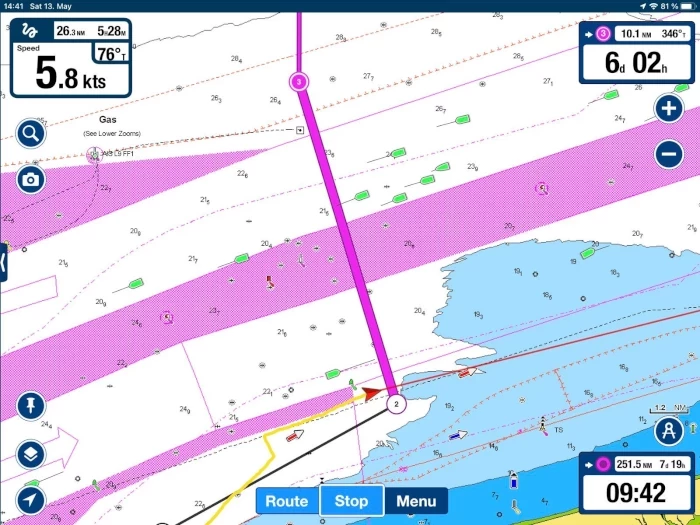
Shortly after passing the first TSZ (Terschelling), an oil platform called us on VHF and asked whether we knew that there was a 500-metre exclusion zone around it. At that point, we were 1.2 nautical miles away. We replied that we hadn’t known but would adjust our course accordingly. He thanked us and wished us a safe journey. After sunset, we passed through the second traffic separation zone (TSZ German Bight Western Approach). For us, that was one of the most thrilling moments of crossing the North Sea: at night and through these heavily trafficked “sea motorways”. Unimaginable without AIS.
Heading for Helgoland – our plan B
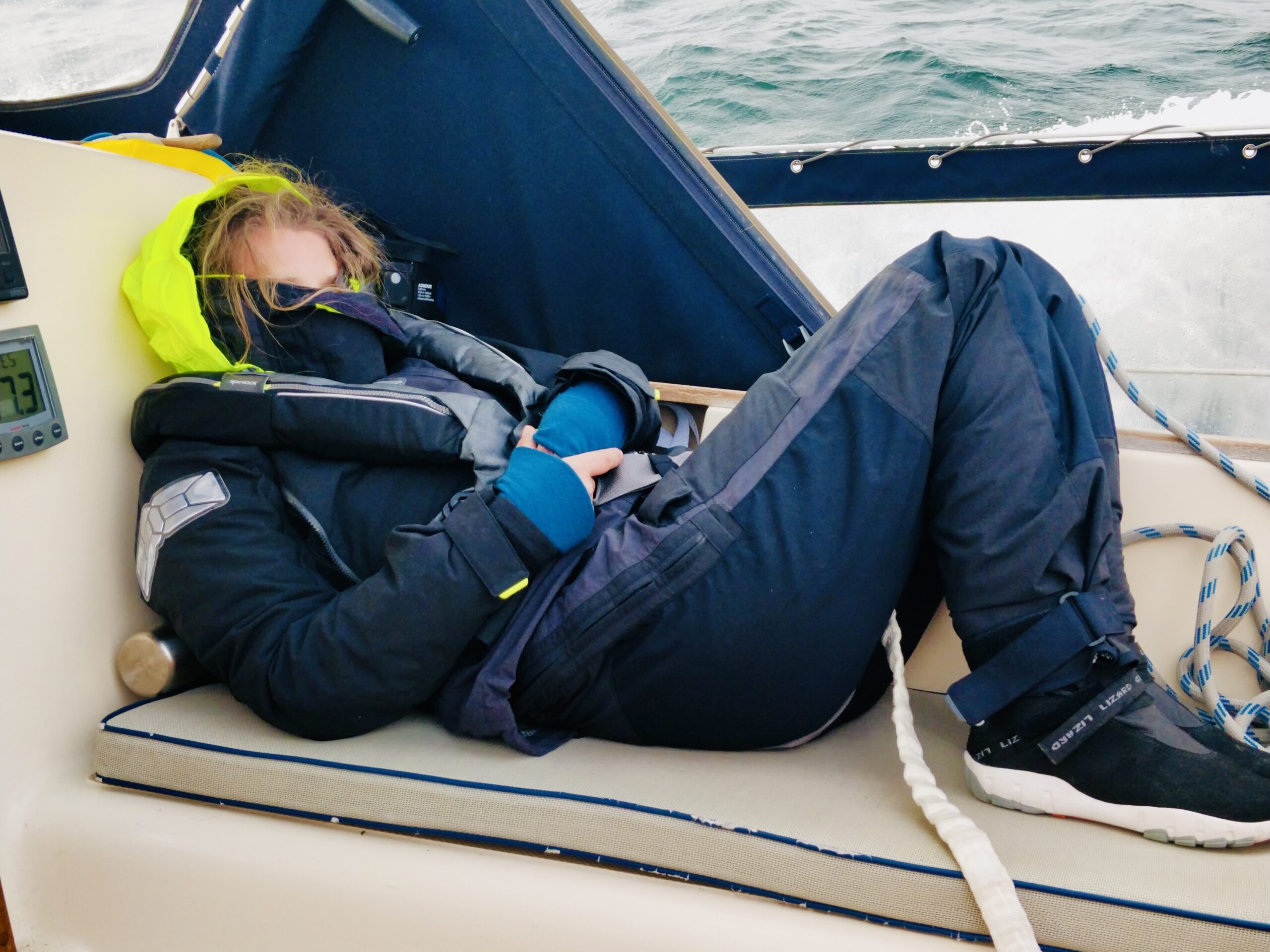
One day had passed, and we were exhausted. We had battled wind and waves for an entire day and night. That wasn’t part of the plan. If the weather forecast for the second day had been correct, we might not have been able to sail but would have had to continue motoring to reach Thyborøn. But we might not have had enough diesel for that. So, we turned off and set course for Helgoland instead.
At first light the next day, we turned off the engine and set the sails, as the wind was much more favourable for Helgoland. But after another ten hours of sailing, the wind completely dropped. So we started up our trusty engine again. After a total of 33 hours, Helgoland came into view.
It was 8 p.m. when we reached Helgoland harbour. The pontoon was full, so we moored alongside another boat and fell asleep soon after. The next morning, we had to get up at 7 a.m. to move the boat, as the one we were tied to wanted to leave early to catch the tide.
What we learned while sailing the North Sea
This was an important milestone for us: our first time on the open sea – no land in sight, no internet, no phone. Just the two of us and the sea. And even though I felt a little queasy at first and even got a bit seasick, I wasn’t scared. I knew we’d see it through together. Looking back, we may have done a few things wrong due to inexperience. We probably shouldn’t have stuck to our course but changed direction straight away towards Helgoland – our plan B. But we were always convinced the wind would eventually turn in our favour so we could sail. That’s something we’ve definitely learned: if the conditions turn out differently than forecast, adapt – and don’t hope for a miracle.