Safety and tracking
Since we knew we wanted to sail on larger waters than the IJsselmeer, one of the pieces of equipment we definitely wanted to have was an AIS transceiver. This way, other ships can see us, and we can see them – as long as both are equipped with AIS. Before our North Sea crossing, we definitely wanted to install one.
A nice bonus feature: anyone who wants to can look up our current position and follow our journey.
What is AIS?
The Automatic Identification System (AIS) enables ships to automatically exchange information via VHF radio with other vessels and shore-based systems, showing ship movements in real time. AIS is therefore essential for improving safety and avoiding collisions.
There are two main types of AIS devices: class A and class B.
Class A AIS devices are mandatory for large vessels such as commercial and passenger ships and are not suitable for smaller craft like ours. They are designed to transmit information more frequently and at higher power (12.5 W) than class B devices (2 W or 5 W), allowing them to be detected from greater distances. The transceiver operates using SOTDMA. Class A devices also provide more detailed information about the ship and its current voyage.
Class B AIS devices are typically used by smaller vessels, including recreational boats and fishing vessels. These devices transmit less detailed data but still share important information such as vessel name, call sign, MMSI number, speed, and course. Nowadays, there are two different transmission modes available for class B transceivers: the CSTDMA system (carrier-sense time-division multiple access) and the SOTDMA system (like in class A).
SOTDMA
SOTDMA (Self-Organising Time Division Multiple Access) is a newer technology compared to CSTDMA. On a class B device, it performs better than CSTDMA in terms of frequency and transmission power (5 W instead of 2 W) but uses a different data transmission method. Unlike CSTDMA, which uses fixed time slots for transmission, SOTDMA organises its own time slots (hence the name). As a result, transmissions are also prioritised within the system.
Our AIS device em-trak B954 – the features
AIS devices can be equipped with a variety of features and capabilities beyond basic sending and receiving functions. Some of these were must-haves for us:
Internal antenna splitter: This feature allows direct connection of the antenna to other radio devices, such as a VHF radio. The splitter enables sharing a single antenna, eliminating the need for a separate AIS antenna. On the other hand, having an additional antenna can serve as a backup for the VHF radio if needed.
WiFi access: Some AIS devices offer WiFi features that allow connection to smartphones, tablets, or other WiFi-capable devices. With this function, we can display AIS data as an overlay on a mobile navigation app (Navionics Boating App, AV Nav, OpenCPN, etc.).
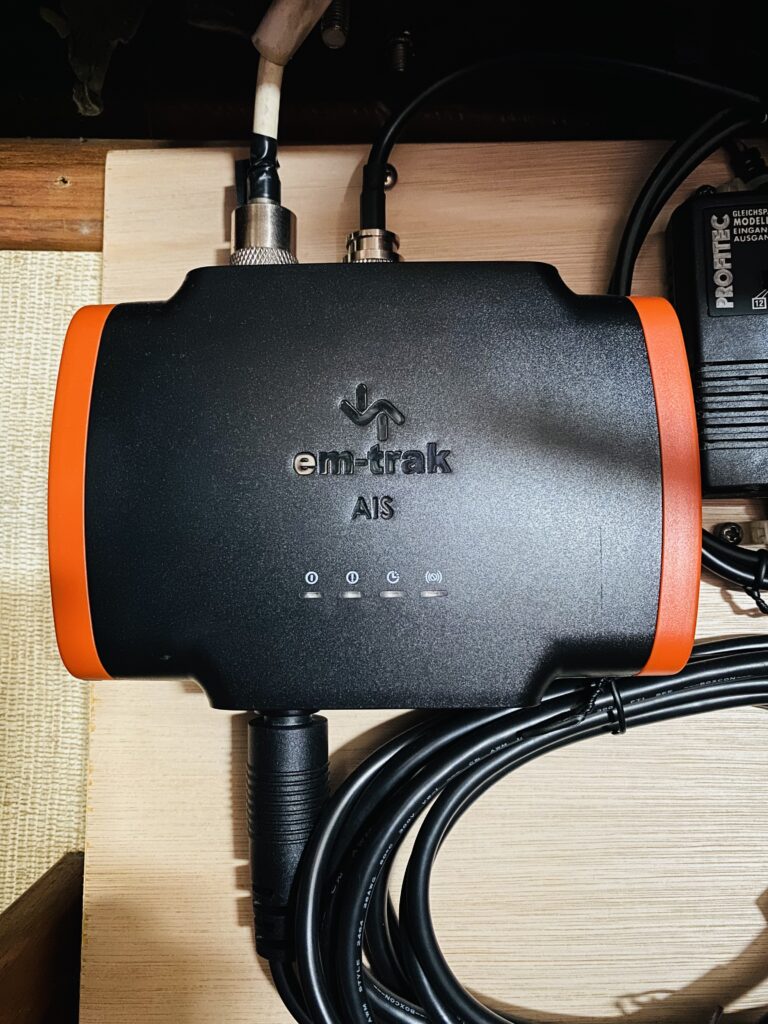
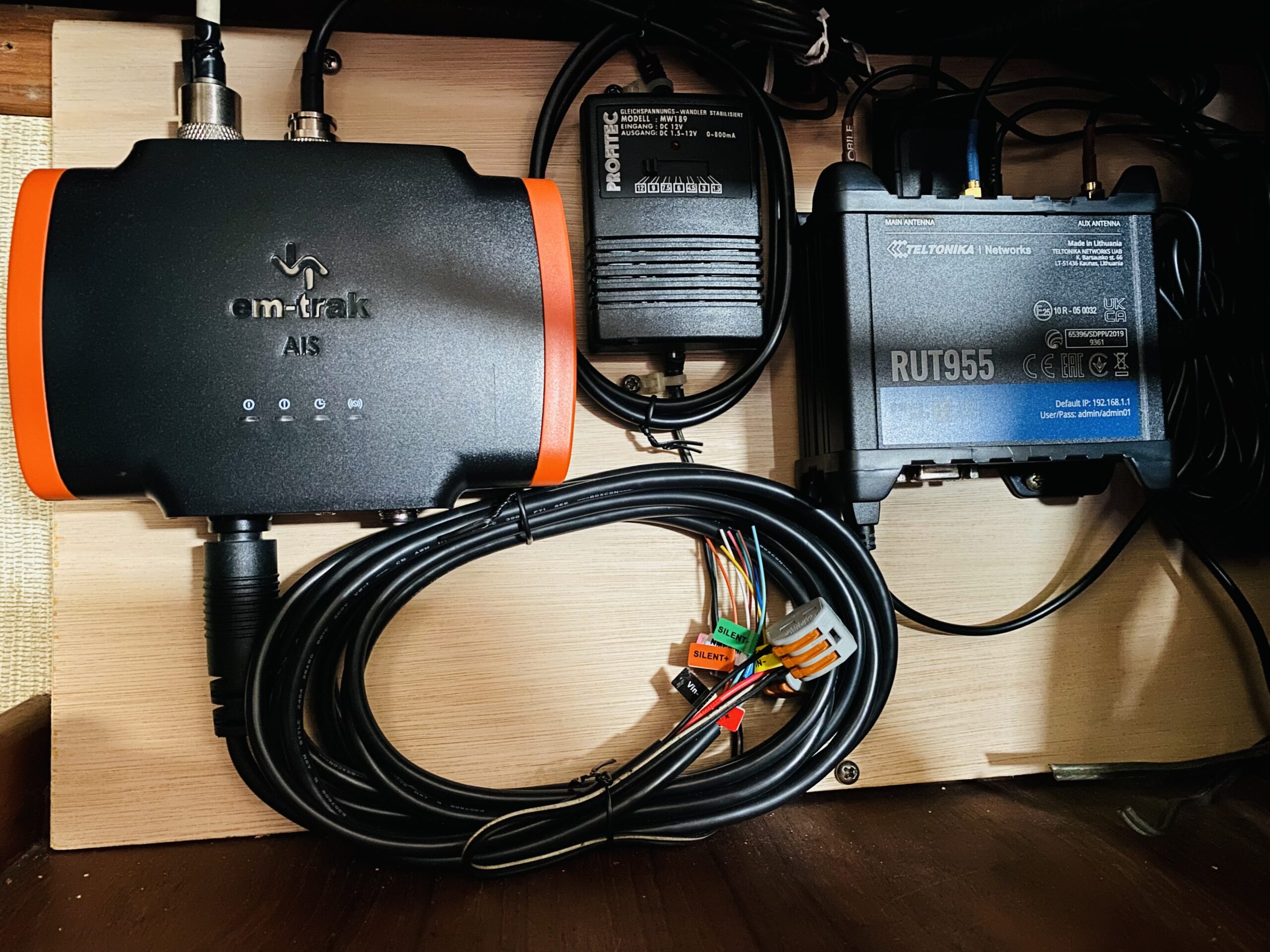
AIS device em-trak B954
The active AIS is a safety feature we would not want to be without. The em-trak performs well. Still, it was actually our second choice. Our preferred device from Weatherdock unfortunately wasn’t available when we wanted to order it.
GPS integration
To provide precise position data that can be shared with other ships, it’s useful for the device to have its own integrated GPS antenna and the option to connect an external one.
Silent mode: Some AIS devices include a “silent mode” function, allowing the vessel to temporarily stop transmitting while still receiving data. This can be handy in situations when we’d rather not be tracked (you never know…).
Choosing the AIS device
In the end, we narrowed it down to two devices:
- em-trak B954 CLASS B
- Weatherdock A20005 easyTRX3-IS-IGPS-N2K-WiFi-LAN
The German Weatherdock easyTRX3 wasn’t available at the time, so we bought the British em-trak B954 instead.
Installation was straightforward, despite the annoying fact that the configuration software (PROAIS2) is only available for Windows OS and MacOS.
Affiliate notice: This page contains affiliate links. If you make a purchase through these links, we receive a small commission at no extra cost to you. Thank you for your support!